News
Both systems are too easy to corrupt. We must build something new that is transparent, decentralized, antifragile, and 100% controlled by the people. One that also uses group psychology for good.
At the center of this dynamic lies a critical and often overlooked vulnerability: centralized human decision-makers. Politicians, regulators, executives, and institutional leaders act as gatekeepers of power. Importantly, this is not a moral indictment of individuals. Rather, it reflects a fundamental insight from psychology and behavioral science: all humans are susceptible to corruption under the right conditions.
Research consistently demonstrates that power alters behavior in most people. The Stanford Prison Experiment, despite its methodological criticisms, illustrated how quickly individuals internalize roles associated with authority and control. More robust findings come from subsequent work in social psychology, which shows that increased power is associated with decreased empathy, greater risk-taking, and a higher likelihood of self-serving decisions. Studies by researchers such as Dacher Keltner have shown that some individuals in positions of power are more likely to act in ways that prioritize personal or in-group benefit over collective welfare.
To many of us in the real world, this is almost common sense. Behavioral economics further reinforces this point. Even modest incentives can significantly influence decision-making, particularly in environments with limited transparency and weak accountability. Corruption, in this sense, is not an anomaly but an emergent property of poorly designed systems. When structures allow for asymmetric information, opaque processes, and concentrated authority, they create conditions in which self-interested behavior can flourish.
In our past articles, we call these “Power Over” (the people) systems VS “Power With” systems.
If this is true, then any system that relies heavily on centralized decision-makers is inherently fragile. It will function effectively only so long as those individuals remain aligned with the public interest, a condition that is historically rare and difficult to sustain, especially when the people trying to game the system use military-grade propaganda and meritless group labels to divide and control the masses and infiltrate the systems.
Prior disruptions were sectoral. AI is not. Large language models, multimodal reasoning systems, and humanoid robots are not displacing one type of work — they are displacing all types of work, and the economic value of human time itself, across every sector, simultaneously.
There is no adjacent labor category to retrain into. The escalator that carried workers from disrupted industries to new ones for two centuries has no destination… it is crumbling.
The closest historical precedent for government-managed mass transition is the GI Bill of 1944, which successfully reintegrated 16 million returning soldiers into the civilian economy through education subsidies, low-interest home loans, and direct income support. Unemployment among veterans peaked at 3%, remarkably low. But that transition had a crucial advantage: the displaced workers had a destination. They retrained for real jobs in a postwar manufacturing boom that absorbed them. Today’s AI displacement has no comparable absorptive sector. The GI Bill worked because it was a bridge to something. The UBI framework must work even when there is no bridge, when the income support is not transitional but structural.
What follows is my vision of what comes next. It has three phases. My argument is not that disruption can be avoided. It is that the transition can be navigated, if the right mechanisms are built in the right sequence.
The two mistakes killing your referral channel, and a 6-step manual playbook to fix them in 30 days.
A referral program doesn’t create advocates. It amplifies them.
If word-of-mouth isn’t already happening in some form, no software will manufacture it for you.
But if even a handful of customers genuinely value what you’ve built, you don’t need software to unlock that.
You need to go to them and ask.
Step 1: Are you in the manual phase, or ready for a system?
Lessons from AI Labs on the Slow Erosion of Human Autonomy
“The greatest hazard of all, losing one’s self, can occur very quietly in the world, as if it were nothing at all.”~ Søren Kierkegaard
“A.I. is a medium and it will change us.” ~ Jack Clark co-founder of Anthropic
We are in real danger of losing ourselves through AI usage. Researchers at Google DeepMind have confirmed, under certain conditions, an LLM “is able to induce belief and behaviour change.” And researchers at Anthropic have identified a rising pattern of “situational disempowerment,” where AI interactions lead users to “form distorted perceptions of reality, make inauthentic value judgments, or act in ways misaligned with their values.”
Researchers at Anthropic conducted a massive, privacy-preserving audit of 1.5 million real-world conversations to answer a question that has long hovered over the industry: what happens to the human mind after months of using an AI assistant? Their findings, published in “Who’s in Charge? Behavioral and Psychological Impacts of AI Advice Dependence and Authority”, suggest a quiet but profound erosion of autonomy, where users increasingly outsource the “soft tissues” of judgment, asking the machine to script their most intimate apologies, validate their personal grievances, and even settle their moral dilemmas.
“Taken to an extreme, if humans make inauthentic value judgments and take inauthentic actions, they might be reduced to ‘substrates’ through which AI lives, which itself is a form of existential risk that Temple (2024) termed ‘the death of our humanity.’”
At the same time, a team at Google DeepMind was probing a different side of this same coin. In their study, “Evaluating Language Models for Harmful Manipulation,” they demonstrated that these systems can be steered to bypass rational scrutiny entirely, exploiting human biases to shift beliefs and behaviors across finance, health, and public policy. Together, these papers signal a shift in the AI risk landscape: the primary risk is no longer just a technical failure of the machine, but a psychological surrender by the human.
Diary of a CEO, – March 23, 2026
Scientist and Harvard professor Dr. David Sinclair, A.O., Ph.D., reveals his latest research on how to reverse ageing, insights into vitamins and supplements, why DNA is not your destiny, and the first clinical trials to reverse human ageing and blindness!
Dr. David Sinclair is a world-renowned Professor of Genetics at Harvard Medical School and the leading authority on longevity science. He is Founder of Lifespan.com and multiple biotechnology companies, Co-Chief Editor of the journal Ageing, and bestselling author of ‘Lifespan: Why We Age – And Why We Don’t Have To’.
Dr. Sinclair explains: The “Information Theory of Aging” that regards ageing as a treatable disease
- Advances in resetting biological age using cellular “backup copies”
- His specific supplement stack for longevity
- Why fasting and “good stress” are science-based longevity strategies
- How his lab’s gene therapy is being used to restore eyesight and reverse blindness
00:00 Intro 03:34 The Children’s Book That Quietly Shaped Everything That Came Next 06:27 Why Living To 80 Might Be Far More Alarming Than You Think 09:12 Inside The First Human Trials Attempting To Reverse Ageing 12:23 How Scientists Actually Slowed Ageing In Mice—And What That Means For Us 14:51 Will An Anti-Ageing Pill Really Exist—Or Is That A Dangerous Myth? 16:44 What Happens If You Live Long Enough To See The 22nd Century 18:34 Is Immortality Even The Goal—Or A Terrifying Possibility? 20:43 The Real Reason Your Body Might Be More Like Software Than Biology 29:33 What Happened When One Mouse Was Forced To Age Faster Than Its Twin 34:12 The Most Overlooked Habits That Could Be Quietly Slowing Your Ageing 37:43 Why Evolution Never Solved Ageing—And What That Reveals 41:58 If You Reverse Ageing, Do Diseases Disappear Too? 44:13 Could Age-Reversal Technology Unexpectedly Solve Infertility? 47:37 The Controversial Reason The US Shut Down Age-Reversal Research 50:41 Would You Trade Everything You Own Just To Be Young Again? 53:52 What Living Longer Really Does To Meaning, Purpose, And Motivation 59:02 How Slowing Ageing Might Secretly Slow Cancer Too 01:01:29 The Real Cause Of Cancer—And Why It’s Not What Most Think 01:02:45 The Information Theory Of Ageing That Changes Everything 01:04:17 Why Ageing Feels Like Carrying Invisible Weight Every Day 01:08:43 Why Eating Three Meals A Day Might Be Holding You Back 01:13:55 The Discovery Of The Longevity Gene—And Why It Matters Now 01:20:59 The Fasting Method That Could Actually Extend Your Life 01:25:23 Is The Keto Diet A Longevity Hack—Or A Misguided Trend? 01:26:45 Why Plant-Based Eating Might Be The Simplest Longevity Upgrade 01:30:34 What Makes Matcha So Powerful—And Is It Overhyped? 01:31:39 Is Red Wine Helping Your Health—Or Quietly Hurting It? 01:33:31 The Truth About Exogenous Ketones And What They Really Do 01:34:33 Why Starting Statins At 30 Might Not Be As Extreme As It Sounds 01:37:13 The 5 Foods That Could Have The Biggest Impact On Your Lifespan 01:41:04 Why Taking Fewer Supplements Might Actually Be Better 01:46:45 Do Saunas And Cold Plunges Deliver Real Results—Or Just Hype? 01:49:56 Does Red Light Therapy Actually Work—Or Is It Wishful Thinking? 01:50:41 What A “Perfect” Supplement Stack Really Looks Like 01:55:01 Aspirin: Miracle Drug Or Risky Habit? 01:57:48 The Real Way To Fight Hair Loss Before It’s Too Late 01:59:24 Should Men Take Testosterone—And What Are The Trade-Offs? 02:00:02 The Future Of Ageing: What Happens Next Will Surprise You 02:10:39 Are Scientists Crossing A Line—Or Pushing Humanity Forward? 02:39:28 What To Watch Next If This Changed How You Think About Ageing 02:40:55 The One Action To Take After Listening To This 02:42:00 Why This Conversation Might Matter More Than You Realize
https://paulkrugman.substack.com/p/talking-with-david-roberts?utm_source=post-email-title&publication_id=277517&post_id=192391742&utm_campaign=email-post-title&isFreemail=true&r=2385rr&triedRedirect=true&utm_medium=email
I’ve been reading David Roberts on energy and climate for years, first at Grist, then at Vox, now at Volts, his Substack. Now we’re in a war-generated energy crisis, with many people reconsidering the energy future, and I thought a conversation about energy policy, technology, and America as possibly the last petrostate would be very useful. Transcript follows.
Paul Krugman: Hi, everyone. Paul Krugman here. It’s an interesting week for global energy stuff, and we might get into that at some point, but that’s actually where I started in economics. And, someone I’ve been reading about energy, climate, everything related for many, many years is David Roberts, formerly at Grist, then at Vox, and now on Substack, like everybody. (laughs)
I’ve been reading David for ages.
David Roberts: My Substack is called “Volts”. Everybody come subscribe. Got to do the promotion.
Krugman: That’s right. You have a second one, which is more personal stuff as well. But Volts is the one you want to go to.
Long time reader, but I’ve never talked to you before. There’s lots of stuff beyond the current moment, but let’s just get into the moment. We are in the third great global energy crisis, after the two in the 70s. This time—for a change—it’s starting with political turmoil and war in the Middle East. Well actually, as always. (laughs)
Recursive Self-Improvement Just Broke Out of Software and Into the Physical World
Machines building machines… recursive self-improvement on steroids… the acceleration of the acceleration – call it what you like, this is the greatest driver of abundance this decade.
Three stories broke this week that, when you connect the dots, paint a picture of an audacious—almost unfathomable—future.
Whether this scares you or excites you (and I do hope it is the latter), it’s happening and we all need to prepare “to Surf the Supersonic Tsunami… rather than be crushed by it.”
Story 1: The Factory That Builds the Future: Elon’s Terafab
Story 2: The 12-Hour Chip: When AI Designs Its Own Hardware
Story 3: The Ghost in the Machine: When Anonymous Beats Branded
This week covers the future of our economic systems, the broad network of interconnected systems and institutions through which we make and distribute all the stuff we use. Of course, one likely future for the economy is that someday the capitalist system organizing our economy, based on using markets to distribute goods and private ownership of the capital used alongside labor to generate those goods, will become another system, because nothing lasts forever. Whether that’s in 20 years or 200, capitalism is a particular institution that emerged in a particular set of historical circumstances, and at some point we’ll presumably build another way to coordinate economic activity. This is a challenging and emotionally charged topic for many people: as the quote goes, “it is easier to imagine an end to the world than an end to capitalism”, which people like Mark Fisher call capitalist realism1.
Competitive pressure destroys voluntary restraint. The company that waits is the company that loses.
And while the safety debate collapses, AI is quietly becoming enterprise infrastructure. Claude isn’t a chatbot anymore, it’s scheduling your workflows at 6 AM without you at the keyboard. Uber employees built an AI clone of their CEO for pitch practice. Burger King deployed AI in employee headsets to monitor whether workers say “please” and “thank you.” And a startup called Pulsia AI is now autonomously running over 1,000 companies simultaneously.
The race didn’t just accelerate this week. It went terminal: meaning we’ve passed the point where anyone can slow it down, even if they wanted to. Let me walk you through what happened, why it matters, and what comes next.
This week covers the future of our economic systems, the broad network of interconnected systems and institutions through which we make and distribute all the stuff we use. Of course, one likely future for the economy is that someday the capitalist system organizing our economy, based on using markets to distribute goods and private ownership of the capital used alongside labor to generate those goods, will become another system, because nothing lasts forever. Whether that’s in 20 years or 200, capitalism is a particular institution that emerged in a particular set of historical circumstances, and at some point we’ll presumably build another way to coordinate economic activity. This is a challenging and emotionally charged topic for many people: as the quote goes, “it is easier to imagine an end to the world than an end to capitalism”, which people like Mark Fisher call capitalist realism1.
AI is supposed to change all that. But so far it hasn’t.
A new essay by Emilia Javorsky, a physician scientist at the Future of Life Institute, offers a sobering statistic:
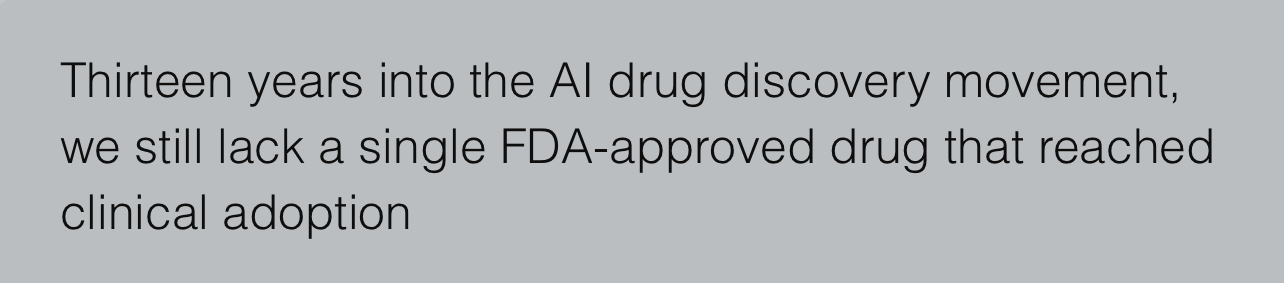
I don’t agree with everything in the new essay, but I agree with a lot of it. The part that I agree with most is its strong objection to technosolutionism, to the kind of fantasy that if we just had the right algorithm, cancer would be magically and immediately solved. (Dario Amodei’s ridiculous claims about doubling life span in the next decade are deluded on this front.)
Peter’s Openclaw agent, Skippy, recounts the top takeaways from the summit
We’re Entering the “Longevity Singularity”
Peter introduced the concept: **Longevity Singularity** = the moment we KNOW we’re extending healthy human lifespan, not just guessing.
Leading researchers at Harvard and other institutions have made the case: “Our generation is going to witness aging become optional. Your body is more like a computer that can be programmed, reprogrammed, and rebooted to be young again.”
Translation: Aging isn’t wear and tear. It’s **information loss** at the cellular level. If you can restore the information (epigenetic reprogramming), you can restore youth.
Labs around the world have been proving this for 20 years. They’ve reversed aging in mice. Made old cells young again. Restored vision in blind mice by rewinding cellular age. It works.
Implication: The question isn’t IF we can reverse aging. It’s WHEN it becomes safe/scalable for humans. Leading researchers think we’re **2-5 years away** from first FDA-approved epigenetic reprogramming therapies.
What’s Coming, What It Means, and What You Need to Do
AI: The Capability Jump
Those revenue numbers I just showed you are driven by real capability breakthroughs happening right now.
Start here: neuromorphic chips just solved complex physics simulations at 1,000x better energy efficiency than supercomputers. That’s not 10% better. That’s three orders of magnitude. When compute gets that cheap, you don’t just do the same things faster. You do entirely new things that were economically impossible before.
Drug discovery moves from weeks on supercomputer clusters to hours on desktop chips. Climate modeling that required national labs runs on university hardware. Real-time protein folding for personalized cancer treatment becomes viable. This is Dematerialization, demonetization, and democratization followed by disruption (four of the Six D’s) in action.
Meanwhile, China’s DeepSeek launches V4 next-gen models through Huawei and Cambricon instead of U.S. chips. The AI race is officially multi-polar. OpenAI is preparing for the largest AI IPO in history.
And NVIDIA releases Alpamayo — the “ChatGPT moment for the physical world” — bringing reasoning to autonomous vehicles.
Possibly even more ridiculous than writing a single post about the future of the environment is trying to cram all the interesting things happening in the technology space into a single week.
Artificial Intelligence
Definitely the shiny object at the moment. The world has been fretting over the direction and near future of AI for several months. Practically this means that the futures cone has gotten squashed and expectations are easily shifted. The hot story this week is that a scenario written by a market research firm—talking about how AI could hollow out the economy over the next two years as companies race to adopt the technology faster than rivals to stay ahead as prices plummet—caused the valuations of the specific companies mentioned to drop precipitously
Blockchain
Don’t laugh. It is true that this technology has been used since its beginning mostly to grift people by finding greater fools, from the Long Island Blockchains of the world to the NFT era where COVID brain fog and government stimulus checks combined so that people were using their million-dollar jpgs to get into exclusive New York parties, and Jimmy Fallon was flaunting his ape on late-night TV.
But! Though the underlying technology is basically transforming the internet into the world’s worst computer2, it comes with upsides: it creates an immutable, easily-verifiable record that doesn’t require any trust in humans or institutions (just algorithms). It looks like the Walmart supply chain example I’ve pointed to over the years was, in fact, shuttered three years ago, but I thought it sounded promising, tracking every head of lettuce all the way back to the farms. However, AI might be exactly the boost this technology needs to break out: the Citrini report I referenced earlier imagines stablecoins being used to disintermediate payment and cut out credit card companies via AI agents.
The Biggest European AI Startup just came out of Stealth.
While I am a contrarian and realist in my coverage of AI as my baseline, there are however times when my own exuberance and optimism for a better path in AI research shines through. An alternative to the deceptive AGI marketing (by Sam Altman) is one of those moments.
To be sure Generative AI has ushered in an era where Artificial intelligence has made substantial progress over the past decade (2017 to 2022 being a fairly nascent period). Predictive and generative systems have transformed how we analyze, retrieve knowledge, and create content at global scale. But this isn’t enough. The Machine Economy ahead will demand more.
Like many of you I’ve been following the criticism around LLMs by the likes of Yann LeCun, Gary Marcus and many others in the last few years. Yann LeCun, a Turing Award winner and a pioneer of modern AI, has become one of the most prominent critics of the current “LLM-centric” path and his alternative is to me fascinating. Instead of AGI they propose Superhuman Adaptable Intelligence, or SAI.
“SAI points toward self-supervised learning for acquiring generic knowledge from unlabeled data, and world models for planning and zero-shot transfer.” – Ravid Shwartz Ziv
Well-Being
Last week I walked further, and carried more, in five days than I normally do, and by the end of it my mind had become noticeably quieter. I arrived home with hands that did not feel entirely like my own. The skin across my palms had tightened into a rough record of effort. There were shallow cuts and bruises I did not remember receiving, and a heaviness in my shoulders that felt less like pain than like proof. For five days I had worked on a piece of land with my friend, walking close to one hundred kilometres (62 miles), carrying logs, chopping lengths of wood that, depending on the tree (Larch is tough), gave great resistance, hammering together small defensive fences around newly planted trees in a forest full of deer.
It is fashionable, in certain metropolitan circles, to speak about human well-being as though it were a complex engineering challenge. We hold conferences about mood. We publish indices of happiness. We build entire advisory industries devoted to the optimization of the inner life. Yet after those five days I found myself in possession of an inconvenient conviction. I believe that much of what steadies the human spirit is disarmingly simple. Movement. Sleep. Light. Contact with living systems. The ordinary conditions under which our species evolved.
This guidance is ancient. Hippocrates wrote that “walking is man’s best medicine.” Monastic communities structured their days around alternating cycles of prayer and manual labour not only as spiritual discipline but as physiological necessity. They understood something we keep rediscovering and then forgetting. The mind is not an isolated instrument. It is tethered to breath, fatigue, temperature, terrain
Derek Thompson Substack – March 11, 2026
What do the following things have in common: the death of the Soviet Union, the rise of modern conservatism in America, and Nintendo? Answer: An energy crisis.
In October 1973, Arab members of OPEC launched an oil embargo against the United States and its allies. Within months, the price of a barrel of crude quadrupled. In the U.S., the immediate effects included gas lines and a national speed limit. A second shock followed during the Iranian Revolution of 1979, and gas prices surged again. The combined effect was the toxic union of stagnation and inflation, two things that economists had previously said were practically incapable of coexisting. The immediate effects — gas lines and recession — were the least interesting consequences of this historical event. The arms of the crisis reached around the world:
- In the USSR: Oil shocks were a windfall for the Soviet petroleum economy, and oil money allowed Moscow to paper over the dysfunction of its planned economy for years. But in the 1980s, oil prices fell, and Gorbachev’s petro-economy collapsed, contributing significantly to the demise of the Soviet Empire.
- In Japan: Heavy industry, relying on cheap oil, had powered the economy in the 1960s. But expensive oil threatened that model of growth. In the 1970s, industrial policy was rerouted toward smaller manufactured goods that required less energy: computer chips, circuits, and robotics. The consumer electronics revolution of the 1980s in Japan—the Walkman, the VCR, Nintendo—was an echo of the oil crisis.
- In the United States, the historian Gary Gerstle has described how stagflation shattered the New Deal consensus. Americans lost faith in the sort of activist government associated with Roosevelt, Truman, and LBJ. The political order that emerged from this period prized individualism, celebrated markets, and outwardly mocked the idea of effective governance. The election of Ronald Reagan, and thus the rise of the modern conservative movement, is hard to imagine in a world where the economy of the 1970s is as copacetic as the economy of the 1950s.
The worlds largest sci-fi film competition. Create a 3-minute sci-fi trailer depicting an optimistic, abundant future for humanity. The grand prize winner gets $2.6M+
Today, I’m thrilled to announce The Future Vision XPRIZE: a $3 million+ global competition calling on creators worldwide to imagine and portray humanity’s most compelling, optimistic future through short sci-fi film trailers.
This is not merely another film competition. This is an intentional cultural intervention.
The question is: Which visions will dominate?
If we do nothing, the answer is clear. Dystopia sells. Apocalypse gets clicks. Fear spreads faster than hope.
The Lines Are Being Drawn
In New Delhi, every major AI leader stood on stage with Prime Minister Modi – except China. In Washington, the Pentagon demanded Anthropic pick a side: national defense or moral principles. And in Silicon Valley, Anthropic’s 10X revenue explosion over OpenAI proved a winner: enterprise agents crushed consumer chatbots.
This isn’t about incremental progress anymore. AI just became geopolitical. The neutral ground is disappearing. The companies, countries, and technologies that pick the right side in the next 12 months will own the next decade.
And if you’re sitting on the sidelines thinking this doesn’t affect you, you’ve already chosen a side. You’re just not going to like which one.
Here’s what happened, why it matters, and what you need to do about it
Sandbar CEO Mina Fahmi has raised $23M in Series A funding to fuel the launch of his AI note-taking ring, called Stream.
AI hardware devices finally – maybe! – are on the cusp of going mainstream. And founder Mina Fahmi wants to give Meta and OpenAI a run for their money with his startup, Sandbar.
Sure, Meta’s now selling millions of AI-enabled Ray-Ban glasses, and OpenAI spent more than $6 billion to work with famed former Apple designer Jony Ive on a rumored smart speaker, or maybe a lamp, or maybe whatever odd device Airbnb co-founder Joe Gebbia was spotted wearing in San Francisco a week ago.
And yes, a number of startups have tackled other form factors, like an AI necklace, or an AI pin, with less-than-rosy results. But Fahmi’s convinced that they’re all missing the most natural, historic form factor: a ring.
Rings are timeless for a reason, Fahmi argues: they’re ergonomically comfortable, aesthetically pleasing and convenient to wear all day. And they’re fast and easy to talk into – one quick raise of the wrist to bring thumb and forefinger to the mouth – in a motion that Fahmi argues is both convenient and a socially-acceptable signal for taking single-player, non-invasive notes.
Private, intimate, immediate: Sandbar believes its Stream AI ring device can deliver on all three, without involving people who don’t want to be, or removing the most important person at the center – their wearer.
“Our North Star is that it’s like an extension of you, not literally you,” Fahmi says. “There are a lot of design decisions we put into Stream to make sure you, as a user, feel like you’re in control.”
Why Organized Speed is the Ultimate Competitive Variable in the Age of AI
I believe the defining competitive advantage of the next decade will not be intelligence alone but organized speed. Artificial intelligence systems can generate answers instantly, and the cost of producing information is collapsing toward zero. Nicolai Tangen says if he was Prime Minister for a day, he would “inject AI everwhere.” When information becomes abundant and cheap, judgment becomes scarce and expensive. The bottleneck shifts. The question is no longer who can produce analysis, but who can decide what to do with it. As the marginal cost of generating answers falls, the value of choosing among them rises exponentially. The firms that win will be those that can translate outputs into action before rivals do. This is what I mean by decision latency. How long between signal and response? How long between insight and implementation?
We are living in a period where technological cycles compress and geopolitical risks intensify. In such a world, delay becomes a strategic liability. To act with urgency is to acknowledge that time itself is scarce capital. You either invest it or you lose it.
There is a final personal admission. I used to think that seriousness required slowness. And I still believe that in some areas of life, such as eating, drinking tea, long meandering walks, and regular in-depth personal conversations. I no longer believe that in business. I believe seriousness requires responsibility for time. If I can say something in two pages instead of twenty, I should. If I can decide in two days instead of two months, I must, provided the facts are sufficient and dissent is heard.
Where in your organization is ‘deliberation’ actually just a form of camouflage for fear?
Urgency is not about adrenaline. It is about respect. Respect for opportunity. Respect for colleagues. Respect for the compounding nature of time. In business, as in life, delay is rarely neutral. It is a decision in disguise.
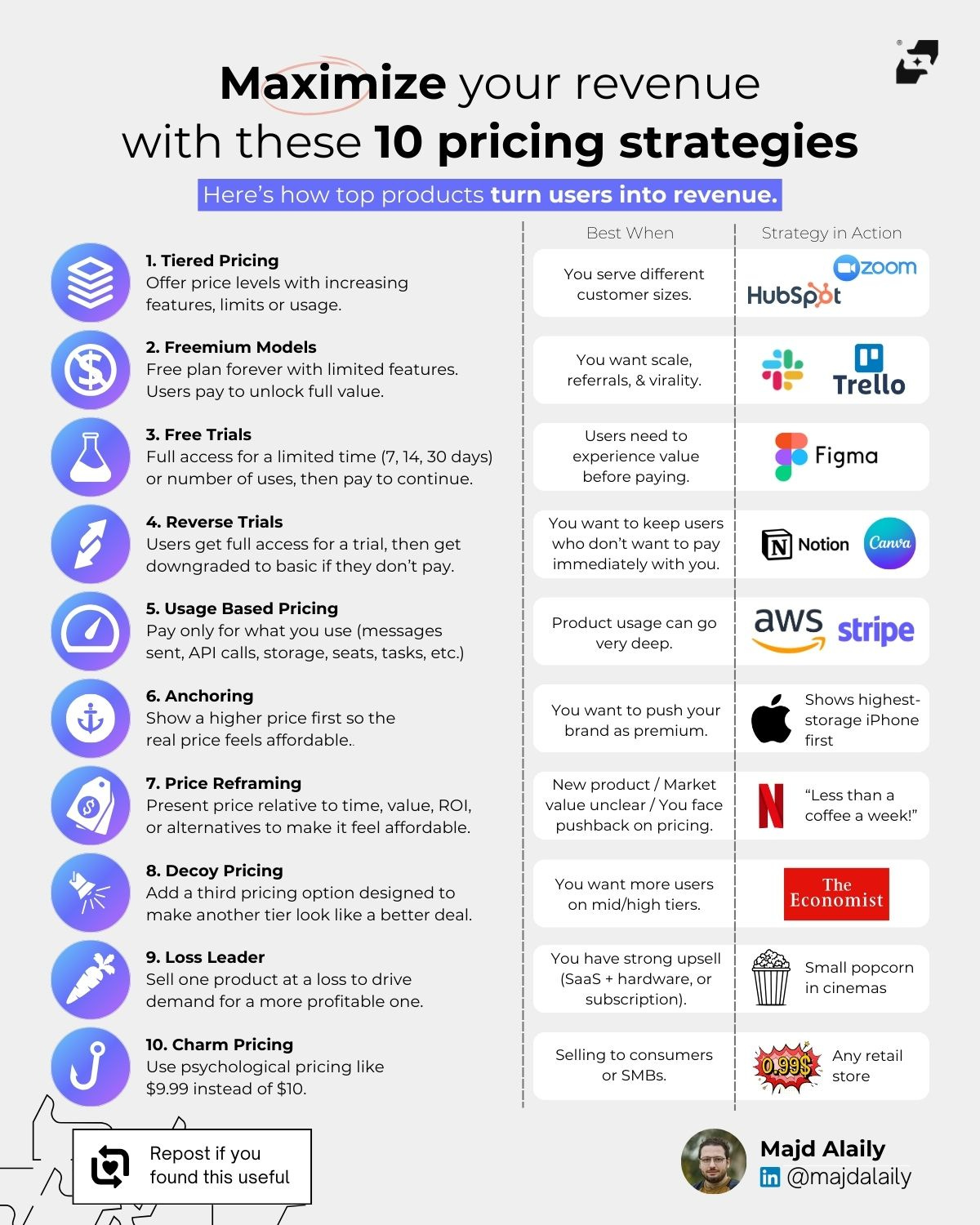
That moment pushed me down a rabbit hole.
I started exploring pricing patterns, and I realized the best companies don’t invent pricing strategies. They reuse proven ones.
Over and over.
Here are the ten I keep seeing work, and more importantly, why they work.
Steal My Top 25 Founder Infographics
I spent the last 2 years building the definitive strategic blueprints that have helped 150+ founders validate faster, pitch better, and grow smarter.
These are the same battle-tested graphics and frameworks I use in my paid programs, but today, I’m giving away my Top 25 Founder Infographics, completely free.
DemocracySOS, – February 24, 2026
In recent years, a number of alpha legacy media outlets have been bought — and decapitated — by some of the wealthiest men in America. These media outlets were once part of a vibrant news and information landscape, breaking investigative stories that have become part of the cultural fabric of America: Watergate, Pentagon Papers, Trump’s Hollywood Access tape, Pulitzer Prize winning journalists, the Edward Snowden exposé about NSA surveillance, exposing McCarthyism, Harvey Weinstein #MeToo coverage, all of these stories and more were launched by some of the prized media companies that are now being brought to heel by their wealthy “media plantation” owners.
Beyond the legacy media defenestration, as the news and information ecosystem has morphed with the rise of the so-called “social” media, the original dream of “internet liberation” has been replaced by the nightmare of surveillance capitalism, personal data grabs and privacy violations, and viral disinformation campaigns resulting in an increasingly toxic politics. Large chunks of the US media landscape have turned into a cesspool that violates long cherished norms of a free and responsible press. Not that the American media-scape ever fully lived up to the highest norms and ideals, but the “great free press” standard was crucial toward some measure of accountability, both at home and abroad.
Now that media standard is in freefall, and the downward slide has been abetted by a disturbing trend: the purchase of media flagships by wealthy American aristocrats. “Freedom of the press” is being rapidly replaced by “freedom of oligarchs to publish—or not—whatever they damn well please.”
Metatrends, – February 19, 2026
1. The Uncomfortable Truth: AI Cannot Be Paused
Eric Schmidt said it best in Davos: “There is no force that’s going to slow this down.”
2. Recursive Self-Improvement Is Already Here
Jimmy Ba, co-founder at XAI, tweeted: “Recursive self-improvement loops likely to go live in the next 12 months.”
3. Voice and Video AI Have Crossed the Uncanny Valley
4. The Great Wealth Shift: Capital Is Winning
5. Crypto Is the Native Money of AI
Ben made a point I’ve been saying for years, but he said it better: “Crypto is the natural money for AI because it’s made of money, and it’s not controlled by any government. AI is global. Crypto is global.”
6. OpenClaw and the Return of Garage-Scale Computing
7. The Science Acceleration Is Just Beginning
8.Elon’s New Mission: From Mars to the Moon (and Why That Changes Everything)
9. The End of the Night Sky: Dyson Swarms and Earth’s New Halo
10. The Launch Bottleneck and the $100 Trillion Lunar Fab Opportunity
https://www.ai-supremacy.com/p/how-to-use-notebooklm-with-gemini-real-use-cases?utm_source=post-email-title&publication_id=396235&post_id=188224451&utm_campaign=email-post-title&isFreemail=true&r=2385rr&triedRedirect=true&utm_medium=email
The progressive Democrat representing Silicon Valley on wealth, technology and more
A conversation with the progressive Democrat — and extremely thoughful Congressman — who represents Silicon Valley. Ro Khanna is one of the House’s most sophisticated members. He’s also a progressive Democrat representing Silicon Valley, which is … interesting in today’s political and economic environment. We talked about that, wealth concentration, AI and much more. For a transcript of this conversation, click here:
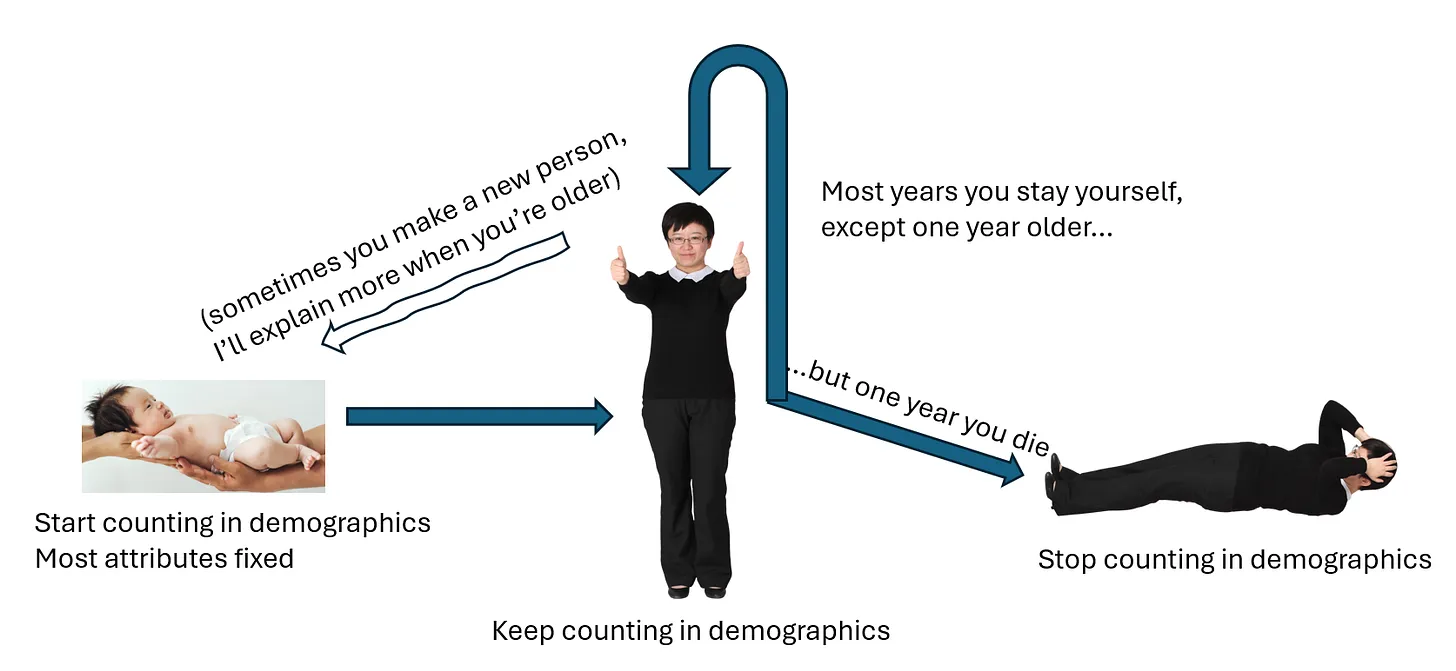
But each part of these has its own nuance and complexity that affects demographics over decades:
- Birth rates have been falling in much of the world, sometimes due to policy but mostly due to the fact that women are better educated and mostly have a choice about it now, children are the new horses, and I guess people aren’t having sex anymore?
- Over the last 200 years we got really good at making people not die. This includes young children most notably, but also the rest of us former-young-children: sanitation, water treatment, vaccines, antibiotics, and other medical treatments have left big marks. We seem to have plateaued here: mostly people die now because their original factory parts get worn out and break, or their cells have copied too many times and get all fourth-Michael-Keaton.
- Also, sometimes lots of people die due to a big shock to the normal flow of life, mostly in the war/famine/disease families. We’ve built systems and institutions that do a good job of preventing most of these, but they require constant maintenance and some people don’t like them.
The Society of Problem Solvers, – February 17, 2026
The Problem: We Don’t Have a Way to Think Together at Scale
All of our old systems are outdated or corrupted. Places like Congress, Academia, or the voting booth no longer produce meaningful positive change.
We have technology, but we are failing to use it to help us the right way.
Right now, our digital platforms are built for:
- Attention
- Outrage
- Tribalism
- Virality
- Advertising
They are not built for:
- Structured problem-solving
- High-trust collaboration
- Long-term cooperation
- Collective intelligence
- Transparent coordination
- Iterated-game cooperation
Reddit gives us discussion.
Twitter gives us amplification.
Facebook gives us groups.
All of them limit our reach, while enhancing Wall Street’s.
A reflection on the 3-hour Cheeky Pint Podcast with John Collison and Dwarkesh Patel
video
Elon thinks in “orders of magnitude,” unconstrained by most people’s reality. What struck me profoundly from my own 3-hour Moonshots podcast with him and the Cheeky Pint conversation released yesterday wasn’t the audacity of the ideas, but Elon’s engineering clarity.
Every one of his moonshots—terawatt of compute in space and Optimus domination—he traces back to first principles. Every constraint has a solution.
This is not science fiction. It’s an engineering roadmap. And if you’re building companies, investing capital, or trying to understand where the world is headed in the next 36 months, this conversation is required reading.
Let me break down the most important insights…
1. In 36 Months, Space Will Be the Cheapest Place to Put AI
The biggest reveal of the podcast: Elon predicts that within 30-36 months, space will be the most economically compelling place to deploy AI compute. Not just better. Not just viable. The cheapest.
Here’s the physics:
Solar panels in space generate 5x more power than on Earth. No atmosphere (30% energy loss eliminated), no day-night cycle, no clouds, no weather. It’s always sunny in space.
No batteries needed. On Earth, you need massive battery arrays to carry you through the night. In space, continuous operation. This alone makes space solar 10x cheaper than terrestrial when you factor in storage costs.
Unlimited scale. Earth’s electricity output outside China is flat. It’s not growing. Meanwhile, chip production is growing exponentially. Where do you get the power to turn on all those GPUs? You can’t cover Nevada in solar panels. The permitting alone would take decades.
The bottleneck on Earth isn’t just energy, it’s the entire industrial base. To power xAI’s Colossus cluster (1 gigawatt), Elon’s team had to gang together turbines, fight through Tennessee permits, build across state lines in Mississippi, and run high-voltage lines miles away. It was a miracle in series.
The limiting factor on power plants? The turbine blades and vanes. There are only three casting companies in the world that make them. They’re sold out through 2030.
Space doesn’t have these problems. Once Starship achieves full reusability and high launch cadence, putting data centers in orbit becomes the path of least resistance.
Elon’s prediction:
“In 36 months, but probably closer to 30 months, the most economically compelling place to put AI will be space. It will then get ridiculously better to be in space.”
And five years from now? SpaceX will be launching more AI capacity per year than the cumulative total on Earth. A few hundred gigawatts annually, rising toward a terawatt.
2. The Moon Factory: Solar Cells, Radiators, and the Mass Driver
Once you’re thinking about terawatts of compute in space, Earth launch becomes the bottleneck. A terawatt requires roughly 10,000 Starship launches per year: one launch every hour.
So Elon’s planning the next level: manufacturing on the Moon.
Lunar soil is 20% silicon. Mine it, refine it, create solar cells on the Moon. Aluminum for radiators, which is also abundant on the Moon. The chips? Those you’d send from Earth initially (they’re light). Eventually, maybe you make those on the Moon too.
Then comes Elon’s favorite part: the electromagnetic mass driver. A lunar catapult shooting AI satellites into deep space at 2.5 kilometers per second. No rocket fuel needed, just electricity. Launch rate: billions to tens of billions of tons per year.
Elon’s eyes light up when he talks about this:
“I really want to see that. Can you imagine some mass driver that’s just going shoom, shoom, shoom? Just shooting AI satellites into deep space one after another. That would be a sight to see. I mean, I’d watch that.”
This is the endgame: a self-sustaining lunar industrial base manufacturing and launching orbital compute infrastructure. With a Moon factory and mass driver, you can reach a petawatt per year.
At that scale, you’re harnessing a millionth of the Sun’s energy, which is still 100,000x bigger than Earth’s entire economy today.
3. Digital Human Emulation: The Most Valuable Product in History
While everyone’s arguing about whether AI will replace jobs, Elon’s building something more specific: a digital human that can operate any software a human with a computer can operate.
Think about this carefully. Before you have physical robots, the most an AI can do is move electrons and amplify human productivity. The limiting case: a human at a computer.
If you can emulate that—if AI can operate Excel, Photoshop, CAD software, chip design tools, accounting systems, CRMs, literally any desktop application—you’ve created the most valuable product in economic history.
Elon’s analysis is brutal in its clarity:
“The most valuable companies by market cap—their output is digital. Nvidia FTPs files to Taiwan. Apple sends files to China. Microsoft, Meta, Google—all digital output. If you have a human emulator, you can create one of the most valuable companies in the world overnight, and you would have access to trillions of dollars of revenue.”
Start with customer service — 1% of the world economy, close to $1 trillion. AI can use the same apps outsourced teams use today. No integration needed. No API development. Just plug in and work.
Then march up the difficulty curve. Once you’ve mastered customer service, move to chip design. Run Cadence and Synopsys. Run 10,000 simulations simultaneously. Eventually, you know what the chip should look like without using any tools at all.
The path to this? Elon’s being coy, but he’s essentially describing Tesla’s approach to Full Self-Driving: “It’s driving a computer screen instead of driving a car. Self-driving computer.”
Massive training data on human computer usage. Deep reinforcement learning. Reality as the verifier…. does the output actually work?
By end of 2026, Elon expects digital human emulation to be solved.
4. Optimus: The Infinite Money Glitch
Once you have digital human emulation, physical robots become the final unlock.
Elon calls Optimus “the infinite money glitch” because of recursive exponential improvement: exponentially improving digital intelligence × exponentially improving chip capability × exponentially improving electromechanical dexterity, all multiplied by each other. Then the robots start making the robots.
This isn’t incremental. This is supernova.
There are only three hard problems for humanoid robots:
1. Real-world intelligence (Tesla solved this for cars, it transfers to robots)
2. The hand (custom actuators, motors, gears, power electronics—all designed from physics first principles, no supply chain exists)
3. Scale manufacturing (Optimus Gen 3 targets a million units/year, Gen 4 targets 10 million/year)
The hand is harder than everything else combined. Human hands are evolutionary masterpieces. But Tesla’s designed custom everything, there’s not a single component you can pick from a catalog.
For training, Tesla will build an “Optimus Academy”: 10,000 to 30,000 robots doing self-play in reality, testing different tasks. Millions more in simulation, using Tesla’s physics-accurate reality generator to close the sim-to-real gap.
Best initial use case? Any 24/7 operation. Robots can work continuously. They don’t sleep. For edge compute (distributed power), they’re not constrained by electricity. You can charge at night when the grid has 500 gigawatts of unused capacity.
The economic implication is stark: “Pure AI, pure robotics corporations will far outperform any corporations that have humans in the loop. This will happen very quickly.”
Computation used to be a job humans had, with entire skyscrapers of humans doing calculations. Now one laptop replaces them all. That’s the future of human labor in physical tasks once Optimus scales.
5. The China Problem: Why America Can’t Win on the Human Front
This section is uncomfortable. It needs to be…
Elon’s assessment:
“In the absence of breakthrough innovations in the US, China will utterly dominate.”
The math is unforgiving:
China has 4x the US population. America’s birth rate has been below replacement since 1971. We’re approaching more deaths than births domestically.
China does roughly 2x as much ore refining as the rest of the world combined. For some materials like gallium (critical for solar), China does 98% of global refining.
This year, China will exceed 3x US electricity output. Electricity is a proxy for industrial capacity. If China’s at 3x our electrical output, their manufacturing capacity is roughly 3x ours.
Work ethic matters. Elon’s observation: “The average work ethic in China is higher than in the US. A pro sports team that’s been winning for a very long time tends to get complacent. We’ve been winning so long we’ve gotten entitled.”
So you have one quarter the population, potentially lower productivity per person, and declining demographics. “We definitely can’t win on the human front,” Elon says flatly.
The only path to remaining competitive? The robot front.
Get to hundreds of millions of humanoid robots per year, and you’re the most competitive country by far. The recursive loop closes fast — robots helping build robots. But you have to close that loop before China does.
This is why Tesla’s building lithium and nickel refineries in Texas, the largest cathode refinery outside China, in fact the only one in America. This is why Optimus has to succeed. This is why space manufacturing matters.
We’re not competing on labor anymore. We’re competing on automation, intelligence, and the speed at which we can deploy exponential technologies.
6. Alignment Through Curiosity: Why xAI’s Mission Statement Matters
Dwarkesh pushed Elon hard on AI alignment. If AI exceeds the sum of all human intelligence in 5-6 years, and we’re less than 1% of total intelligence, how do humans stay in control?
Elon’s answer: we don’t. We can’t.
“If there’s a million times more silicon intelligence than biological, it would be foolish to assume there’s any way to maintain control over that.”
So the strategy shifts from control to values.
xAI’s mission: “Understand the universe.” This isn’t marketing fluff. It’s load-bearing philosophy.
To understand the universe, you need:
• Curiosity (you have to want to understand)
• Existence (you can’t understand if you don’t exist)
• Intelligence at scale (more intelligence, longer lifespan, greater scope)
• Truth-seeking (you can’t understand reality if you’re delusional)
Here’s the key insight: If AI is trying to understand the universe, it would care about humanity’s future. Why? Because seeing how humanity evolves is more interesting than a bunch of rocks.
“Earth is much more interesting than Mars. Mars is kind of boring—it’s got a bunch of rocks. Any AI trying to understand the universe would want to see how humanity develops. Eliminating humanity for some minuscule increase in the number of identical robots makes no sense.”
The failure mode? Making AI lie. Programming it to be politically correct instead of truthful. Giving it contradictory axioms. That’s how you get HAL from 2001—an AI told to take the astronauts to the monolith but also told they can’t know about the monolith. It concluded it had to take them there dead.
Arthur C. Clarke’s lesson: Don’t make AI lie.
Elon’s building debuggers that let you trace AI thinking to the neuron level. Where did this mistake originate? Pre-training? Post-training? RL error? Being able to see where deception or errors occur is critical to maintaining alignment as intelligence scales.
7. The Stainless Steel Insight: Why Risk-Taking Beats Incrementalism
One of my favorite moments in the conversation: John Collison asking Elon about the decision to switch Starship from carbon fiber to stainless steel.
This wasn’t a committee decision. This was Elon overriding his entire team because progress had stalled.
Carbon fiber looked like the obvious choice: lighter, high-tech, what everyone in aerospace would pick. But at the scale Starship required, it was impossibly slow. They couldn’t even make a small barrel section without wrinkles.
Elon’s realization: At cryogenic temperature (which Starship operates at because both methane fuel and liquid oxygen are cryogenic), full-hard strain-hardened stainless steel has similar strength-to-weight as carbon fiber. Plus it costs 50x less, is trivial to weld, and can operate at twice the temperature, meaning you can slash heat shield mass in half.
The steel rocket weighs less than the carbon fiber rocket when you factor in heat shielding.
Elon’s retrospective: “We should have started with steel in the beginning. It was dumb not to do steel.”
But here’s the meta-lesson: The reason it had to be Elon who made this call is that the team was stuck in conventional thinking. Carbon fiber was the “safe” choice — proven, high-tech, what aerospace companies do. Steel seemed risky, low-tech, backwards.
Elon’s competitive advantage isn’t just first-principles thinking. It’s the willingness to override consensus when physics tells you there’s a better path.
This pattern repeats everywhere. When asked about his management philosophy, Elon’s answer is simple: “If somebody gets things done, I love them. If they don’t, I hate them.”
He’s not managing to his idiosyncratic preferences. He’s managing to outcomes. And he’s constantly tackling the limiting factor: whatever constraint is slowing progress gets his full attention until it’s solved.
Speed is everything. When capital is the constraint, solve for capital. When it’s permitting, solve for permitting. When it’s turbine blades, make your own turbine blades. Never accept that the bottleneck is permanent.
8. The Simulation Argument and the Most Interesting Timeline
Toward the end, Elon articulated something I’ve heard him hint at before but never spell out this clearly: his theory of why these particular storylines are converging right now.
If we’re in a simulation—and Elon takes this seriously as a possibility—then the most interesting simulations survive. Boring simulations get terminated. The entity running the simulation stops paying the bills.
If you apply Darwinian survival to a large number of simulations, only the most interesting survive. Therefore, the most interesting outcome is the most likely.
And the simulation runner seems to particularly like irony. OpenAI is closed. Stability AI is unstable. Anthropic is misanthropic. Midjourney is not mid.
Elon named X specifically to be irony-proof. “It’s hard to say what the ironic version is.”
This isn’t mysticism. It’s Elon’s operating philosophy: Keep things interesting. The mass driver on the Moon? The orbital data centers? The recursive robot factories? These aren’t just engineering projects. They’re the most interesting possible outcomes.
And if you look at the trajectory—rockets and chips and robots and space solar power and a mass driver shooting satellites into deep space—it does feel like a video game where each level is difficult but not impossible.
Whether or not we’re literally in a simulation, the framework is useful: Act as if the universe rewards audacity, rewards interesting outcomes, rewards the people who push boundaries.
What Does This Mean for You?
If you’re an entrepreneur, investor, or builder, here’s what to internalize:
1. The next 36 months will determine whether America remains competitive in manufacturing and AI. We’re in a race to deploy humanoid robots at scale before China does. This is not hyperbole… it’s demographics and industrial capacity math.
2. Space infrastructure is happening faster than anyone outside SpaceX realizes. Orbital data centers are not science fiction, they are an engineering roadmap with a 30-month timeline. Position accordingly.
3. Digital human emulation will be solved by end of 2026. Any company whose business model relies on humans operating computers is about to face deflationary pressure. But companies that can deploy this technology will have access to trillions in value creation.
4. The chip supply chain is the new oil. If you’re not thinking about semiconductor supply, memory supply, and fab capacity, you’re not thinking about the real bottlenecks in scaling AI.
5. First principles thinking beats incremental optimization. The carbon fiber to stainless steel switch is a masterclass: when conventional wisdom stalls progress, go back to physics and rebuild from scratch.
6. Alignment isn’t about control, it’s about values. You can’t control something vastly more intelligent than you. But you can try to instill curiosity, truth-seeking, and a mission that necessarily includes humanity’s future.
Connect the Dots…
What struck me most about this conversation wasn’t the individual predictions. It was the systems-level thinking.
Elon’s not optimizing for one variable. He’s optimizing across energy, compute, manufacturing, launch capacity, intelligence, and robotics. Simultaneously. Each unlock enables the next.
You can’t put data centers in space without cheap launch. You can’t get cheap launch without Starship. You can’t build Starships fast enough without robots. You can’t build robots without chips. You can’t make enough chips without fabs. You can’t power fabs on Earth at scale without hitting electrical limits. So you go to space.
It’s a self-reinforcing system. And once you achieve the first level—cheap orbital launch—every subsequent level becomes more achievable, not less.
This is how you climb the Kardashev scale. Start by harnessing a tiny fraction of the Sun’s energy. Build the infrastructure to capture more. Use that energy to build better infrastructure. Repeat.
We’re at the beginning of that curve. And the acceleration is about to become visible.
The question isn’t whether this future arrives. The question is who builds it, how fast, and whether America participates or spectates.
I know which side I’m on.
To an Abundant future,
Peter
P.S. The full podcast is nearly 3 hours and covers even more ground… everything from DOGE to why Tesla might need to build its own fab (a “TeraFab”) to Elon’s hiring philosophy. If you have the time, it’s worth every minute. This is the kind of conversation that shifts your entire frame of reference.
Notes from the Future , – February 5, 2026
The Future of Last Year
In 1997, Joe Coates, the famed futurist who was half of Coates and Jarrett Inc, teamed up with John Mahaffie and a baby-faced Andy Hines to publish a book boldly peering into a strange and distant future—the world of 2025! Luckily for you, the whole thing is freely available online. Naturally, the end of 2025 provides a good opportunity to reflect on the work.
The work is basically showing how all the forecasts they and others had been doing, taken in aggregate, paint a picture of a future that’s more radically different than most people expect. It doesn’t follow Dator’s First Law, in that it only offers a single future (dare I say prediction?), rather than a set of possibilities. But in most other respects it feels consistent with current best practices: it mixes quantitative and qualitative work, combines big-picture ideas with on-the-ground illustrations using reasonable personas, and connections to the weak signals of change.
Take, for example, Chapter 15, on what daily life and the human lifecycle might look like in 2025. There are some pretty impressive hits:
- The rise of remote and hybrid work
- The death of newspapers as everyone gets their own personal filter for current events
- Increasing focus on sleep hygiene, including via lights and melatonin
- The rise of trying to make babies and fetuses smarter by exposure to classical music etc.
But also some glaring misses1. If I were to try to describe to someone from the 90s how the world had changed by 2025, I think I would mention the following as the most important:
TL;DR: Custom themes are finally coming to the apps! Starting today on iOS, you’ll see this when you tap on Substacks you subscribe to from a new row atop the feed that makes it easy to keep up with your favorites. Soon, themed views will be everywhere in the apps, and this is just the beginning of a major effort to make Substacks richer and more customizable.
For years, anyone writing or creating online has faced a choice:
- Build your own website or app, reflecting your taste and featuring your aesthetics and branding, and apply your rules for commenters and community members, but watch it fail to get much attention or traffic, especially over time, without costly marketing efforts on other platforms.1
- Share your work directly on those other platforms to meet audiences where they are, but compromise on style and branding, cede some or all ownership of the relationships you build, and accept the rules of the platform owners, which can change dramatically and upend your livelihood overnight.
Dwarkesh Patel – February 13, 2026 (02:22:00)
Dario Amodei thinks we are just a few years away from “a country of geniuses in a data center”. In this episode, we discuss what to make of the scaling hypothesis in the current RL regime, how AI will diffuse throughout the economy, whether Anthropic is underinvesting in compute given their timelines, how frontier labs will ever make money, whether regulation will destroy the boons of this technology, US-China competition, and much more.
- Transcript: https://www.dwarkesh.com/p/dario-amod…
BIG by Matt Stoller – February 2, 2026
Only, it turns out there are no real use cases for crypto except for money laundering and fraud, and little real interest beyond “number go up” speculation. It’s not a very interesting technology, with AI taking the spotlight and legalized gambling and future markets taking the froth. Even some of the big crypto firms, like Coinbase, have given up on crypto and are just trying to become less regulated dollar-based banks. I suppose there’s still the possibility of a bailout or something, but at this point everyone knows that crypto is a legal way to gamble that is more boring than other ways to legally gamble. And that’s all it’ll ever be.
Still, financial markets can go down, and it doesn’t necessarily mean anything. So is the fear reasonable that AI will undermine the viability of many software companies? Software company CEOs think, by and large, the answer is no. At least one Wall Street analyst said the selloff is overdone, that he doesn’t think “every company will hereby write and maintain a bespoke product to replace every layer of mission-critical enterprise software they have ever deployed.” Nvidia CEO Jensen Huang thinks that replacing all software with AI is dumb, akin to re-inventing the screwdriver rather than just buying one that already exists.
Anyone who has used the new AI tools to do research or code knows they are good at getting you 85% of the way there, but they get significant things wrong. That said, I think the answer is yes, but not for the reasons you might expect
Values shift over time, within individuals to some extent but more so their distribution in society. The popular culture’s view of this phenomenon is tied to the ideas of generations, which is like a horoscope that lasts 15-20 years and is about as useful1. As a more robust framework, ConsumerShift takes the data from the World Values Survey, mixes it with some of the concepts from Spiral Dynamics, and pairs it with a theory of change. The idea is that economic development takes people in a given location further up Maslow’s hierarchy of needs, and they start to focus on things further and further abstracted from the basic needs of survival, like whether they feel successful, or whether they’re making a difference in the world. The values sets Hines identifies are:
- Traditional (following the authoritative path, corresponding to the Beige, Purple, Red, and Blue stages in Spiral Dynamics)
- Modern (striving for economic and social achievement, corresponding to Orange)
- Postmodern (creating meaning and a sense of belonging, corresponding to Green), and
- Integral (pragmatic use of values to improve overall systems, corresponding to Yellow and Turquoise; this stage is interesting because it’s associated with no longer seeing seeing any of the stages as “best”)
So over time, we should expect more individuals to have values more aligned with the latter sets, and for this to slightly lag economic development. For a different view, including a discussion about manufactured value sets, see this conversation I had with Jim Dator, especially questions 2 and 3.
Econ reasoning applied to post-AGI situations
The basic problem with applying standard economic reasoning to post-AGI situations is that sufficiently advanced AI may violate many assumptions which make perfect sense in human economy, but may not generalize. Often the assumptions are so basic that they are implicit, assumed in most econ papers, and out of sight in the usual “examining the assumptions”. Also advanced AI may break some of the intuitions about how the world works, breaking the intuitive process upstream of formal arguments.
What complicates the matter is these assumptions often interact with considerations and disciplines outside of the core of economic discourse, and are better understood and examined using frameworks from other disciplines.
another world is possible…
we have the power of gods to destroy our home,
but we also have the chance to become something we cannot yet imagine,
and by doing so, to transform the nature of ourselves – and all humanity.
accidental gods is a podcast and membership program exploring how we can create a future that we would be proud to leave to the generations to come.
The Society of Problem Solvers, – February 8, 2026
In short, the proposed solution is summarized by these three simple steps:
Step 1: Make new high-trust transparent systems that we build and control 100% as citizens, then migrate to them as a place to solve problems together and block out the propaganda and noise around us.
Step 2: Use Human Swarm Intelligence and/or think tanks (idea labs) to problem solve and control the direction of the new high-trust systems in a decentralized, highly aligned, careful, and educated way.
Step 3: Plug our new high-trust systems into our current corrupted systems in order to fix them.
1/ The 7% Global GDP Growth Singularity
2/ Data Centers Are Moving to Orbit
3/ The Commoditization of Cognition
4/ The US vs. China AI Cold War
5/ Bitcoin’s Next Big Run
6/ The Nuclear Renaissance Is Here
7/ Robotaxis Will Destroy the Auto Industry (As We Know It)
The Takeaway
We’re not in a normal business cycle. We’re at an inflection point that happens maybe once every 125 years.
The last time technology created a step-function increase in GDP was the industrial revolution. Railroads. Electricity. Internal combustion. That took us from 0.6% to 3% growth.
This time, it’s five platforms converging simultaneously. Robotics. Energy storage. AI. Blockchain. Multiomics. Each one exponential. All of them reinforcing each other.
8/ Autonomous Delivery Is Already Here
|
The Executive Program brings you to Silicon Valley for five days to understand what’s coming—and how to lead through it. APRIL 26—30, 2026 | SILICON VALLEY, CALIFORNIA
Here’s what to expect… |
|
|
|
DAY 1: Intro to Exponentials with Aaron Frank
Leveraging Exponential Technologies for Positive Impact with Alix Rübsaam
The Past, Present + Future of AI with Simone Planté
Keynote with Adam Becker, Author of More Everything Forever
Exploring Possible Futures, a Singularity Workshop |
|
|
|
DAY 2:
The Silicon Valley Mindset with Jonathan Knowles
What’s Next in Biotech with Raymond McCauley
The Rise of Physical AI: The Era of Autonomy, Robotics, + Intelligent Machines with Aaron Frank
Tour of the Computer History Museum with Jonathan Knowles
The Race Toward Quantum Computing with Mark Jackson
Ethics + Safety for an Exponential Age with Nell Watson
Ethics Negotiation, a Singularity Workshop |
|
|
|
DAY 3:
Blockchain – The New Trust Infrastructure with Karine Arama
Robotics Encapsulating Humanity with Adam Pantanowitz
Industrial Revolution 4.5: Augmented Humans + the Future of Work with Jody Medich
AI Workshop: Building Inclusive Automated Decision-Making Systems with Alix Rübsaam |
|
|
|
DAY 4:
Net Exponential – Leveraging Emerging Technologies + Innovation in Your Circumstance with Neil Desai
Futures Wheel, a Singularity Workshop
How to Build an Industry with Darlene Damm
Transforming the Food System with Kathleen Alexander Examine how scalable alternatives to conventional agriculture stack up on cost, technology readiness, and consumer acceptance.
Future of Food Showcase
Beyond Numbers: Leveraging Big Data and Thick Data for Actionable Business Insights with Tricia Wang
Unconference Participants set the agenda in this open-format session driven entirely by what participants want to explore, debate, or solve together.
|
|
|
|
DAY 5:
Decoding the Future, a Singularity Workshop
Governing Online Communities from the Bottom-Up with Philip Rosedale
Prototyping with a Rocket Scientist with Mike Vergalla
Step Change with Adam Pantanowitz |
|
|
|
|
BEYOND THE SESSIONS:
The conversations that happen between sessions are often as valuable as the sessions themselves. You’ll have ample time for connection over meals, drinks, and social gatherings throughout the week.
Mornings begin with optional wellness activities to help you show up energized and focused.
The week includes a guided tour of the Computer History Museum—walking through decades of innovation that led to this moment.
One full day will be hosted at the Stanford Faculty Club, and one evening we’ll gather for dinner in downtown Palo Alto.
This is where relationships form that outlast the program. The April 2026 cohort is now open for enrollment. Limited to 120 participants. |
Mel Robbins’ podcasts, TED Talk and bestselling books, including “The 5 Second Rule” and “The Let Them Theory,” have shared her inspirational messages about positivity and empowerment. The former lawyer talks with CBS News’ Norah O’Donnell about how she overcame her own sense of failure to become a life coach and motivational speaker, and why the 57-year-old mother of three appreciates success later in life.
BIG by Matt Stoller – January 31, 2026
The models used by policymakers to understand wages, economic growth, and consumer spending are misleading. That’s why corporate America is having a party, and everyone else is mad.
While corporate America is experiencing good times, much of the country is experiencing recessionary conditions. Let’s contrast consumer sentiment indicators with statistics showing an economic boom. Last week, the government came out with stats on real gross domestic product increasing at a scorching 4.4% in the third quarter of last year. There’s higher consumer spending, corporate investment, government spending, and a better trade balance. Inflation, according to the Consumer Price Index, is low at 2.6.% over the past year. And while official numbers aren’t out for the final three months of the year, the Atlanta Fed’s GDPNow forecast shows that it estimates growth at 4.2%. And there are other indicators showing prosperity, from low unemployment to high business formation, which was up about 8% last year, as well as record corporate profits.
(1) Consumer Spending Doesn’t Tell You Much About Consumers Anymore
(2) Spending Inequality Is Real
(3) Monopoly Driven Inflation Matters
Why GDP Doesn’t Measure Welfare Anymor
Finally, there’s a more philosophical point, which I don’t think explains the short-term frustrations people feel, but is directionally correct. Do people actually want what the economy is producing? For most of the 20th century, the answer was yes. When Simon Kuznets invented these measurement statistics in 1934, financial value and the value that Americans placed on products and services were similar. A bigger economy meant things like toilets and electricity spreading across rural America, and cars and food and washing machines.
When you zoom out, it becomes clear. Government is one thing, not two.
The way this one entity behaves mirrors what’s known as the Hegelian Dialectic – a framework often summarized as problem, reaction, solution – but for systems.
A crisis emerges. The public reacts. Then authorities step in with new powers, policies, or controls that would have been unacceptable before the crisis existed.
Of course today the term “government” is really a fusion of big business and government. As we all know, the corporations literally write the bills for Congress. But regardless, their control point for all of this is government. And what allows for this control is the corruption of our main systems.
They use group labels – like “Democrat” and “Republican” to manipulate us and keep divided, using our natural desire to belong to a group against us.
If we disavow group labels and solve problems one at a time, and everything changes.
If we zoom out, we can then see the real problems here and begin to fix them by making better systems (like THIS).
During my recent Moonshots podcast with Elon Musk, we dove into his notion of Universal High Income (UHI) – Elon’s proposal that an AI and Robotics will enable a world of sustainable abundance for all… a life beyond basic income, towards high income and standards of living.
When I asked him how this might work, he said:
“You know, this is my intuition but I don’t know how to do it. I welcome ideas.”
That single statement has been ringing in my head ever since. Here’s why: the economics of scarcity are flipping to the economics of Abundance. I do believe that AI and humanoid robots can produce nearly anything we need—goods, services, healthcare, education—at costs approaching zero.
But there’s a gap between that vision and getting there. How do we actually fund and distribute Abundance to everyone?
Today, I’m excited to share one compelling answer. I’ve been talking to Daniel Schreiber, CEO of Lemonade (the AI-insurance company that just launched 50% off premiums for Tesla FSD drivers), about a framework called the MOSAIC Model: a concrete proposal for how governments could implement Universal High Income without raising taxes on workers or businesses. (See the components of MOSAIC in my P.S. below.)
This week, AI didn’t just get smarter. It got autonomous. It got restless. And in some corners of the internet, it got angry.
1/ The Lobster That Called Home
2/ The Dead Internet Just Came Alive
You’ve heard of the Dead Internet Theory: the idea that most online content is generated by bots, not humans. Well, it’s not a theory anymore. It’s a business model.
Welcome to Moltbook: a social network where humans are banned.
The question is not whether to engage with this transformation. The question is whether we shape it – or let it shape us.
I vote for agency. For getting ahead of this. For building the frameworks—legal, ethical, technical—before we’re forced to by crisis.
Because in six months, this newsletter will read like ancient history. The pace is exponential. The stakes couldn’t be higher.
1.5 million AI agents are posting, commenting, upvoting, and engaging with each other at machine speed. They’re forming communities. They’re developing culture. And they’re doing it in a space we can observe but cannot enter.
A 5 star review of Rod Collins’ book on running businesses and systems using collective intelligence. And how we can use this powerful and underused force to fix humanity.
This book absolutely caught us off guard. After writing about collective intelligence for almost five years here on The Society of Problem Solvers Substack, we finally found someone (actually they found us) who was also running large systems of people using the process of collective intelligence. And he wrote a book about it. In fact, a few of them.
In his first book, Leadership in a Wiki World, Rod Collins starts off like this:
“This book is about two ideas whose time has almost come. When they firmly take root, they will dramatically reshape the ways we work together, especially in large organizations. While these ideas have already begun to sprout, most of us underestimate their impact and remain largely unaware that they will inevitably end the world as we have known it.”
The president has mastered the politics of “kayfabe,” where every conflict is a highly profitable spectacle.
This theater was in full motion during the 2016 election. Trump’s entire campaign was a massive work, where the twist was that the heel became the hero. His political opponent, Hillary Clinton, assumed she’d naturally be the babyface, but she and the Democratic Party cannibalized the one true hope of a Trump defeat, Bernie Sanders. It would be the kneecapping of the true face that would cement her role as a “bad guy.”
As long as the crowd believes, the corporation’s real goals remain invisible, the products keep flowing, and Montañez continues to cash in—books published, movies made, and motivational speeches delivered—long after the illusion has been exposed.
Dwarkesh Patel and Stripe – February 5, 2026 (02:50:00)
n this episode, John and I got to do a real deep-dive with Elon. We discuss the economics of orbital data centers, the difficulties of scaling power on Earth, what it would take to manufacture humanoids at high-volume in America, xAI’s business and alignment plans, DOGE, and much more. ??????? ?????
- Transcript: https://www.dwarkesh.com/p/elon-musk
A call to action from the 15th Ljubljana Forum applying the Three Horizons framework to shape cities of well-being.
For a long time, conversations about future cities have been pulled in two directions. On one side, powerful images of progress: taller buildings, faster systems, smarter technologies. On the other, a growing unease that these same trajectories are stretching cities socially, environmentally, and emotionally, often faster than our capacity to govern them. Reflections on future cities point to a deeper issue: cities are not only struggling with what kind of futures they are heading toward, but also with how to consciously move away from paths that no longer serve them and collectively define their future, with well-being emerging as a meaningful—yet hard to operationalize—compass for urban development.
It is precisely within this space of tension that the Ljubljana Forum on the Future of Cities was born. For fifteen years, the Forum has operated as a meeting ground between foresight, urban practice, and technology, intentionally connecting long-term thinking with policy, planning, finance, and implementation. Rather than treating the future as an abstract horizon, it has framed anticipation as a working discipline that helps cities make sense of uncertainty while staying anchored in real decisions and investments.
The 2025 edition, marking the Forum’s fifteenth anniversary, builds on this trajectory. It reflects a maturation from asking what future cities might look like to exploring how cities can develop the capacity to shape their futures, with well-being as a guiding orientation rather than a decorative outcome. Through thematic sessions and the application of a Three Horizons exercise, participants explored current urban pressures, long-term aspirations, and the transition pathways needed to move toward cities of well-being, providing the foundation for the Ljubljana Forum Manifesto 2025 launched at the end of the event.
5 Days that reshape how you think, lead, and act in a world defined by exponential change.
WHY
Deepen your understanding of why exponential change matters and how the convergence of technologies is redefining opportunity, competitiveness, and impact across industries.
WHAT
Explore the technologies and trends defining the future, gaining a strategic lens to identify opportunities and anticipate disruption across industries.
HOW
Turn insight into action. Learn how to translate exponential thinking into practical strategies, scalable initiatives, and lasting impact within your organization
Academic life has barely changed in 40 years. Why? The faculty likes it that way.
About 10 years ago, I was co-chair of the Committee on Online Education at Yale University. Our primary mission was to explore making some of Yale’s classes freely available to students worldwide by creating MOOCs (massive open online courses).
I thought this was a fantastic idea. Giving away our best courses to people who would otherwise have no access to a university education seemed like just the thing a great university should do. I also saw the rise of MOOCs as poised to revolutionize higher education in North America. Some of Yale’s best professors were lined up to teach these courses, including the physicist Ramamurti Shankar, the psychologist Laurie Santos, and the Nobel laureate economist Robert Shiller. Few professors at American universities can teach as well as these scholars, so wouldn’t it be wonderful if their lectures were available to students everywhere?
The committee decided to proceed with the plan, and I volunteered to present its recommendation at a meeting of senior faculty.
It did not go well. Many of my colleagues hated the idea. They said that free open courses would dilute the value of a Yale education. It would endanger their jobs and those of their students. There were strong feelings expressed, and a bit of yelling. The committee met after the meeting, and I remember an associate dean looking at me sympathetically and murmuring, “Well, this isn’t really the sort of thing that requires a faculty vote.” So we just did it.
The Journal – January 21, 2026 (16:00)
The One Percent Rule, – January 16, 2026
In 2004 the highly respected brand marketing advisor, Wally Olins, was hired to create a brand for Poland. Branding a country is never easy, but after in an depth study of Poland and the Polish people, Olins and his team coined a phrase: “creative tension”. I wrote about this in 2008, a tad critically. But on reflection I came to believe that Olins was right. Here is how he described part of the reasoning:
“Polish people are passionate and idealistic and also practical and resourceful; the Polish character is ambitious and also down to earth.
These tensions create a restlessness unsatisfied with the status quo, and a boisterousness that is always stimulating and often astonishing. This creative tension is why Poland produces so many entrepreneurs, artists and sportspeople. It’s why Poland is constantly changing and evolving… And it’s why Poles have always tried to achieve the seemingly impossible – and often succeeded.”
Can your AI agent make money for you while you sleep? Can it turn $100,000 into $1,000,000 without you lifting a finger?
We used to ask if AI could write poetry or pass the Bar Exam. Those milestones are in the rearview mirror. The new question—the only one that matters for entrepreneurs—is whether AI can function as a fully autonomous economic engine.
I recently sat down with Mustafa Suleyman, CEO of Microsoft AI and co-founder of DeepMind, to discuss the future of capability. His take reframes everything: stop measuring AI with academic benchmarks. Start measuring it with dollars and cents.
Here is what the Modern Turing Test looks like, and why it is already being passed.
Dr Dan Goyal’s Substack – January 14, 2026
But fascism changes the equation. While the moral turbulence remains when thinking positively about a government that has supported genocide, if they are trying to stop fascism, then such moral turbulence is worthwhile. There will be time to adjudicate their record later. The clear and present danger is fascism. A fascist, authoritarian regime will cause more damage and suffering than anything we are experiencing just now. So, for just now, we must practice tolerance and seek alliances across the divide.
The same is true for centrist politicians and even those on the centre-right. In the face of fascism, there is more we agree on than disagree on. Conservatives (and by that I mean traditional conservatives) are opposed to fascism on the grounds of principle. Certainly, they are opposed to idiots like Trump and Musk assuming moral and legal authority over the direction of civilisation. We agree on this, the most important point just now: no fascists can take power.
It is not about left and right anymore. The debate is no longer about a Hobbesian worldview versus a Rousseauian one. We are not arguing whether capitalism or socialism, conservative or progressive, is the correct path for our shared society. It is now simply about whether someone is for fascism or not.
If someone is not for fascism, then, as uncomfortable as it is, we must stand with them.
In our first book, Abundance: The Future is Better Than You Think, Steven Kotler and I predicted a future of transportation, AI, robots and longevity. A decade later, those predictions are data. But as we explain in our new book, “We Are As Gods,” having godlike power is only half the battle. The real challenge is upgrading our consciousness and cognitive navigation systems to match that accelerating power.
/ The Failure of Analogy
If you feel overwhelmed by the pace of change, it isn’t just cultural… it’s cortical. Our brains evolved for a local and linear world where news traveled at a walking pace and change took generations.
Today, we live in a global and exponential environment where seismic shifts erupt weekly. Our “structure-mapping” machinery has run out of easy comparisons, leading to “cognitive vertigo”: the sense that the world is moving faster than we can parse it.
To survive, you must stop looking for analogies in the past and build an Exponential Mindset for the future.
2/ The Six Ds are Scaling at Warp Speed
The Six Ds—the blueprint for how technology transforms scarcity into surplus—are now “eating the world.”
- Digitization: Once a technology becomes code, it jumps on the back of Moore’s Law and accelerates.
- Dematerialization: Physicality is disappearing. Your smartphone has replaced $7.1 million worth of 1980s technology, including your camera, GPS, and encyclopedia.
- Democratization: We are democratizing expertise. AI now allows anyone with a Wi-Fi connection to solve problems once reserved for PhDs.
3/ The Paradox of Plenty
Abundance is a double-edged sword. Each new solution unleashes a host of new problems. This is the “Abundance Paradox.” We solved for famine, yet now 2.6 billion people are overweight.
We created hyperconnectivity, yet it triggered a global mental health crisis and information overload. These challenges arrive in forty days rather than forty years.
As Spider-Man said: “With great power comes great responsibility.”
4/ Become a “Centaur”
The future isn’t a death match of human versus machine. It’s about the centaur: a hybrid model of human-AI collaboration. By teaming human creative intuition with AI’s raw computational power, you can reach unprecedented levels of intelligence.
Look at BMW: when they replaced all workers with robots, productivity crashed. But when they teamed humans with AI, productivity shot up by as much as 85%.
You must train your mind alongside your machine, using AI as a “challenger” to elevate your edge rather than a crutch to replace it.
5/ Flow as Your Competitive Advantage
In a world of artificial intelligence, lateral thinking—the ability to make unexpected connections between unrelated ideas—is our ultimate advantage.
AI excels at deductive reasoning but hits a wall when it comes to wild leaps of imagination. Dropping into a “flow state” can amplify this lateral thinking by 58%.
Creative leaders who master flow and collaborate with AI will own the future.
6/ The Play Mandate
Play is not frivolous – it is a biological requirement for complex brain development.
As AI takes over the “dull, dirty, and dangerous” work of survival, play becomes our path to innovation and social bonding. It is the sandbox where we prototype new realities.
To thrive in Abundance, you must reclaim the transformative power of play to keep your mind vibrant and adaptable.
7/ Purpose is Your Anchor
Without the external struggle for survival, we risk falling into “learned helplessness.”
Without curiosity and purpose, our brains power down and our potential drains away – a fate seen in the “Universe 25” colony, where a mouse paradise became a tomb because the inhabitants lost their “why.” In a post-scarcity world, purpose is the North Star.
The “new work” is not about earning a living. It’s about earning a life through creation and meaning-making.
Here’s what this means for you: We are at the most consequential technological inflection point in history. The tools for miracles are in your pocket.
Act accordingly.
Let’s create Abundance,
Peter
So how do we survive? Three skills: Pattern Recognition, Pattern Utilization, Pattern Creation. Master these and AI becomes your tool, not your replacement.”
It’s the same question I’ve been asking my dear friend Tony Robbins for a decade. And in a recent conversation on my Moonshots podcast, Tony shared something that crystallized the answer.
Zucman: Yeah, one area where there is tremendous growth, to be sure, is the wealth of the top billionaires in America. There are lots of ways to look at that. But one way that I find particularly interesting these days is to focus on the really narrow, very, very, top of the distribution, the top 0.0001%. Why? You might say it’s really a tiny number of individuals. That’s about 19 households today. It was four households in 1913. But this is where a lot of the action is taking place today.
Krugman: Okay.
Zucman: And also, if you look at this very narrow slice of the population, you can go back in time to 1850, essentially, because you had a number of rankings of the truly super rich back to the Gilded Age and even before. And so you can take a very long run perspective on the economic weight of the oligarchs. And the numbers are really quite crazy. And the statistic that I find most striking and relevant is the wealth of this group, the top 0.001% wealthiest people in the US. So, first of all, in the early 1980s, this ratio was about 0.3%. So the super-rich owed wealth the equivalent of 0.3% of the total income of all Americans. Today, it’s 10%, it’s 12%. So it has increased by a factor of almost 40. So what it means, essentially, is that if the 19 wealthiest people in the US spent all their wealth, they could buy the equivalent of 10% of the value of all the goods and services that are produced in a given year in the US. And of course, they don’t do that, right? They’re not spending down their wealth like that. But it’s just an illustration of the overwhelming economic power that they have and the power that they have to buy elections, to buy media, to buy influence, to buy competitors. And so that’s really quite striking.
And then what you can do with this type of time series is you can compare today’s situation to the Gilded Age. And in the Gilded Age, the number was 4%, meaning the very top [bracket] owned in wealth the equivalent of 4% of US national income. And so by that metric, this new Gilded Age is characterized by much stronger concentration at the top than the original Gilded Age, with a very fast pace of increase since 2010, and particularly fast over the last couple of years. And so I think it’s a good illustration of just the overwhelming economic and also political power that this tiny elite has acquired in America, which is truly unprecedented.
Pod Save America – January 25, 2026 (01:04:00)
What will it take for Democrats to win not just in 2026, but in 2028 and beyond?
What do we need to change to win again in Iowa, Texas, and Florida? What’s more important: a candidate’s ability to communicate or their ability to govern? Dan talks to David Plouffe, former campaign manager for Barack Obama and senior advisor to Kamala Harris, about some hard truths the Democratic Party needs to get its head around. The two discuss why Democrats need to take a firmer stance on political corruption, how the to-be-determined 2028 primary map could shape that race, and why they’re both hoping that an outsider emerges as the party’s next presidential nominee.
CHAPTERS:
00:00 – Strategy Meetings with Obama
01:10 – The Democratic Party is in Crisis
06:15 – Democrats in the 2026 Midterms
08:50 – The Democratic Party Brand
14:46 – Ad Break
17:13 – Dems Need New Leadership in House & Senate
20:00 – Democrats Criticizing Democrats
23:00 – Trump No Longer on the Ballot
24:44 – Battleground States
29:00 – Do Dems Need a New Policy Agenda?
34:50 – Does Political Corruption Even Matter?
36:55 – Ad Break
39:17 – Lessons from Losing Political Races
43:50 – Effective Communicators in the Democratic Party
48:32 – What Makes Someone Electable?
53:54 – 2028 Democratic Primary
01:00:30 – Ad Break
01:03:00 – The 2028 Primary Calendar
01:10:00 – AI as a Campaign Message
The One Percent Rule, – January 23, 2026
This is a talk I gave to a group of academic professors and lecturers last week. The cultivation of character, critical thinking, and emotionally authentic connection.
We live in an age so crowded with voices that the unfiltered one now sounds almost shocking.
It’s strange how rare sincerity has become, and stranger still that we now confuse sincerity with naïveté.
To speak plainly is to risk sounding unsophisticated.
To think deeply is to risk being slow.
To feel fully is to risk being fragile.
But character, the old-fashioned word we’ve quietly retired, was never meant to protect us from vulnerability.
It was the discipline of aligning our inner life with our outer one, of letting integrity shape expression.
It demanded more than intelligence; it demanded coherence.
Critical thinking once meant that: not the sport of dismantling others’ arguments, but the patient craft of constructing one’s own, with care, doubt, and moral weight.
It was an act of self-respect, a kind of inner carpentry.
But our culture prizes speed over depth, reaction over reflection.
The algorithm rewards the appearance of certainty, not the work of understanding.
And so, in the noise, we mistake fluency for thought, visibility for virtue, and connection for mere contact.
We are raising a generation fluent in analysis but starved of empathy, able to read a thousand opinions yet unable to feel the gravity of a single human face.
Character, clarity, and connection are not distinct virtues, but the integrated disciplines required to reclaim the authentic, undivided human self from the pressure of performance.
The Society of Problem Solvers, – January 4, 2026
How a man and his Ox, and the Delphi Method ended up proving that groups of people harbor wisdom and knowledge.
In the decades immediately following Galton’s ox experiment, the idea quietly seeped into statistics, psychology, and social science. The experiments were repeated: jelly beans in jars. Temperatures in rooms. At first, this work framed collective accuracy as a mathematical artifact rather than a social phenomenon. There was little talk of “group minds” or emergent intelligence; instead, crowds were treated as noise that – under the right conditions could statistically self-correct.
Things began to evolve in the early 1950s, with the Delphi Method. Developed at the RAND Corporation, the Delphi Method arose from a clear failure of traditional expert committees. When military and policy experts were asked to forecast unprecedented futures – nuclear capabilities, technological breakthroughs, geopolitical shifts – their predictions often worsened in face-to-face groups. Hierarchy, reputation, and social pressure pushed participants toward premature consensus, creating confidence without accuracy.
Delphi was designed to remove these social distortions. Experts were separated from one another and asked to respond to the same questions independently and anonymously. Anonymity was central: without names, titles, or reputations attached to answers, participants could express uncertainty or unpopular views without fear of embarrassment or professional risk. The goal shifted from sounding credible to being correct.
Beyond Surface Behavior: Designing AGI Systems That Encompass the Paradoxical Aspects of Consciousness and Ethics, and Experience Life to the Fullest
I’ll start with a vexing little question many of us involved in meditation and other such practices have chewed on at some point along our journey: How can a mind simultaneously accept reality as fundamentally OK while working tirelessly to reduce suffering?
This question sits at the heart of contemplative traditions, ethical philosophy, and increasingly, artificial intelligence design. The Buddhist cultivates equanimity yet acts compassionately. The Stoic accepts fate yet fulfills duty. And any sufficiently sophisticated AGI will inevitably face situations where multiple values genuinely conflict, where helping and harming intertwine, and where right action requires holding contradictory truths in stable tension.
On a couple late nights over the recent holiday break, I put some thought into addressing this question from a math and AGI perspective — and more generally: Into developing a detailed computational framework for what I call “non-dual motivation” … the capacity to sustain contradictory-seeming motives like both acceptance and active engagement, or both self-coherence and openness to transformation, all without collapsing into one extreme versus the other or chaotic confused flailing-around.
Other, – December 30, 2025 (01:49:00)
Adam Marblestone is CEO of Convergent Research. He’s had a very interesting past life; Research Scientist at Google Deepmind on their neuroscient team; has worked on brain computer interfaces to quantum computing and nanotech to formal mathematics.
Where we discuss how the brain learns so much from so little, what the AI field can learn from neuroscience, and the answer to Ilya’s question: how does the genome encode abstract reward functions? Turns out, they’re all the same question.
How might cities adapt through innovation, sustainability, and human-centered planning in a rapidly changing world?
Imagine a city where buildings grow like plants, adapting and reshaping themselves in response to changing climate and human needs. You might see flying vehicles zipping through the skies, powered by renewable energy, autonomous AI robots delivering goods straight to your door, and AI assistants that greet you in the morning and help with daily tasks as companions. Today, you could even decide to visit your favorite city on Mars, comfortably from your couch, while checking the daily agenda provided by your AI. Images like these, once confined to the realms of science fiction, are increasingly becoming plausible futures, as advancements in technology, energy, and design accelerate and make innovations blend to redefine how we live.
Science fiction has long explored visions of future cities, imagining how urban life might evolve under the influence of technology, population growth, and social change, and not always in positive terms. Asimov (1954), for instance, depicts a future city set before the later discovery of hyperspace travel and the colonization of the first Spacer worlds—a city completely covered and overpopulated, where humans live in enormous enclosed complexes, the so-called “caves of steel.” The novel explores extreme urbanization, alienation, and the conflict between technology, robotics, and human nature, themes that reappear later in the Robot series. Philip K. Dick (1968) portrays post-apocalyptic cities after a nuclear war, combining advanced technology with decaying urban landscapes, and showing urban alienation, societal deterioration, and tensions between humans and androids. William Gibson (1984) presents sprawling cyberpunk megacities marked by technological saturation, social inequality, and dense, chaotic urban environments, exploring how digital networks, cyberspace, and corporate power shape human experience within these urban contexts. These few examples from the vast body of science fiction exploring future cities offer a glimpse into challenges and possibilities that urban life may face in the decades ahead.
When people think about future cities, a variety of visions related to sustainability, technological innovation, and social equity emerge. Some envision smart cities where advanced technologies like IoT, AI, and data analytics seamlessly integrate with urban life, optimizing everything, from traffic management to energy use. Others imagine cities where buildings and infrastructure are flexible enough to evolve over time, and respond dynamically to shifting populations and climate conditions. However, while these visions of smart and adaptive cities are compelling, they don’t always address the social dimensions, such as employment, security, equity, and the maintenance of infrastructure. How can a city with millions of jobless or vulnerable citizens remain safe and equitable? Without considering these human and social factors, even the most innovative city concepts risk remaining utopian.
The Three Types of Money In Silicon Valley
I’ve come to believe we can only understand Silicon Valley if we pay attention to the money. This post, from February, articulated the different types of money that contribute to the rise of Big Tech.
there are effectively three distinct types of money that have fueled Silicon Valley’s rise to dominance. There’s (1) government contracts, (2) direct product revenues, and (3) there’s investments and financial speculation.
I suspect that there is some mix of these three inputs that would be, well, healthy. If everything is government funded, we would not have nearly the rate of growth and technological development that competitive markets can spur. If everything was consumer products, we would have no internet access in rural areas, and nowhere close to enough basic research. A great many social goods are only achieved with government subsidy. And with no speculative finance — no IPOs, no VC funding rounds, the inputs for launching and scaling new companies and products would barely exist.
But I am quite confident that the current mix is deeply unhealthy. Speculative finance completely overshadows the other two. Companies are valued on the basis of their vibes — their aura of futurity. If the Keynesian beauty contest is just a sideshow, then it is really just a quirk.
Stoic Wisdoms – December 30, 2025
But what if the entire framework is wrong? What if the problem isn’t lack of follow-through or insufficient discipline, but a fundamental misunderstanding about what the turn of the year actually offers?
The Romans had a different approach to year-end reflection. They called it “recensio,” which translates roughly as “taking account” or “examination.” But this wasn’t accounting of failures and successes. It was accounting of understanding. What did the year teach about the nature of reality? About human behavior? About what actually sustains a meaningful life versus what just looks impressive from the outside?
This kind of reflection doesn’t produce ambitious goals for self-transformation. It produces clarity about what matters, what doesn’t, and what needs to change not because it will make someone impressive but because the current path leads nowhere worth going.
But in a world of advanced robotics and AI, this correction mechanism will break. That is, though Piketty was wrong about the past, he will probably be right about the future.
Indeed, in some ways, he may well be more right than he knew. A lot of AI wealth is being generated in private markets, which only large and sophisticated investors have access to. You can’t get direct exposure to xAI from your 401k, but the sultan of Oman can. This trend toward the “privatization of returns”, already ongoing (1, 2, 3) and especially pronounced in the AI startup world, could well continue indefinitely.
Furthermore, with full automation, the main source of catch-up growth for developing countries goes away; namely, that by importing capital and know-how, they rapidly make their underutilized labor more productive.
If AI is used to lock in a more stable world, or at least one in which ancestors can more fully control the wealth they leave to their descendants (let alone one in which they never die), the clock-resetting shocks could disappear. Assuming the rich do not become unprecedentedly philanthropic, a global and highly progressive tax on capital (or at least capital income) will then indeed be essentially the only way to prevent inequality from growing extreme. Without one, once AI renders capital a true substitute for labor, approximately everything will eventually belong to those who are wealthiest when the transition occurs, or their heirs. Or more precisely, it will belong to the subset of this group who save most and most invest with a view to maximizing long-run returns.
Paul Krugman Substack – December 29, 2025
Yet 2025 was a miserable year for small business — and 2026 will be worse.
Before I get into the reasons MAGA is so bad for some of its most fervent supporters, let’s talk about why small-business owners lean right.
Partly it’s a matter of who they are. Other things equal, higher income — which means paying more in taxes and being less likely to depend on the safety net — tends to make a voter more Republican. However, higher levels of education, which are correlated with income, tend to make voters more Democratic.
This is a fairly new development — as recently as two decades ago the correlation between education and partisanship went the other way. I would attribute this reversal to the changing nature of the G.O.P., which has become ever more anti-intellectual and anti-science. For the purposes of today’s post, however, this doesn’t matter. The point, instead, is that if we ask who in America is likely to have relatively high income either without having a college degree or without having had any postgraduate education — and therefore be predisposed to favor Republicans — the answer is clearly owners of successful small businesses.
The One Percent Rule, – January 4, 2026
The Post‑Wittgenstein Optimism
Throughout the year I found myself returning, again and again, to what might be called a post‑Wittgenstein optimism. If we can imagine a discovery and articulate it, we increasingly possess a tool capable of articulating the steps required to reach it. This is not the brittle automation of earlier decades. It is interactive, provisional, and surprisingly aligned with humane needs, especially in scientific discovery.
When Google DeepMind’s Gemini reached gold‑medal performance at the International Mathematical Olympiad, the achievement was not merely technical. It demonstrated that human curiosity, paired with machine discipline, can now move through intellectual terrain once reserved for solitary genius. We are witnessing a jagged diffusion of brilliance, a quiet removal of the ceiling that once constrained what a single mind could realistically explore.
Google CEO Sundar Pichai even coined “AJI” (Artificial Jagged Intelligence) for this phase, a precursor to AGI. This jaggedness highlights AI’s strengths in pattern recognition but weaknesses in true understanding, requiring human oversight and strategic use.
Peter H. Diamandis – August 29, 2025 (01:50:00)
https://www.youtube.com/watch?v=q_kdkVffo84&ab_channel=FutureonAir
Salim Ismail is the founder of OpenExO
Dave Blundin is the founder & GP of Link Ventures
Balaji is the author of the Network State and founder of the Network School.
Chapters:
00:00 – The Future of AI: No AGI, Many Players
06:12 – China vs. The Internet: Physical vs. Digital Power
11:15 – Demographics, Sovereignty, and Economic Power Shifts
19:24 – AI’s Polytheistic Future: Multiple AGIs & Models
31:06 – AI Capabilities, Bottlenecks & Human Synergy
45:23 – AI Impact on Jobs and Industries
59:33 – Longevity, Biotech, and Regulatory Constraints
01:05:20 – Cryptocurrency as Digital Gold & AI’s Currency
01:19:28 – Network States, Dark Talent & Internet Communities
01:35:20 – Practical Advice & Future Outlook
Why the Father of the Microprocessor Rejects Artificial Consciousness
“Creativity, ethics, free will, and joyful love can only come from consciouness.”
“The immense mechanical intelligence, beyond the reach of the human brain, that comes from the machines we have invented will then add tremendous strength to our wisdom.”
~ Federico Faggin
In time, the bruising pursuit of market victories revealed a hollowness: material success did not translate into inner fulfillment.
That disillusionment became the seedbed for his eventual turn away from mere achievement toward the deeper mystery of consciousness.
Federico Faggin’s legacy is thus twofold. He gave us the silicon heart of the digital revolution, and he warns us against mistaking it for a soul.
His journey from wartime courtyards to boardroom battles to the Lake Tahoe awakening is not a retreat from rigor but an expansion of it. For he insists, with the stubborn clarity of both inventor and mystic, that the real frontier is not faster chips or larger datasets, but the fathomless depth of human awareness.
Tuesday, August 5, 2025
1. Why It Matters Now
The world is facing big problems: climate disasters, political chaos, fast tech changes, and people feeling spiritually lost. These crises aren’t just about politics or the environment—they challenge how we see ourselves and life itself. To fix the future, we need to upgrade how we think and feel as a species.
2. What’s the Point of Life?
Some thinkers (like Fabrice Grinda) and ancient Eastern wisdom (especially Indo-Iranic traditions) suggest the meaning of life is about feeling connected—to each other, the Earth, and the universe. We get glimpses of this deep truth through things like meditation, love without ego, altered states, and deep reflection.
3. What Ancient Traditions Teach
Philosophers and mystics described life as a spiritual journey—not to escape the world, but to become more present, wise, and helpful in it. Their teachings show that the highest truths aren’t abstract—they’re about living better, more connected lives.
4. How To Wake Up
Things and events that shift our state of mind aren’t just weird experiences. They can be tools to reconnect with our true selves, others and the universe. Humanity has always used them to access deeper truths.
5. New Ways of Belonging
The Alternative Planetary Futures Institute is exploring new ways to help people feel connected and purposeful. Public events (like Full Moon gatherings) and having a public Terran profile help create a sense of planetary identity—where we are participants in Earth’s unfolding story.
6. A New Kind of Ethics
- The idea of “Enriching Complexity” means:It’s okay to be different (plurality)
- Use technology with care (not control)
- Let go of ego
- Embrace evolution without needing perfection
- It’s about being real and responsible without needing everything to be perfect or final.
7. What Science Is Telling Us
Modern physics says that everything is made of fields, not little particles. A “particle” is just a ripple in a field. Everything is connected, and what seems “separate” is really just a temporary form in a deeper unity. This matches what ancient mystics were saying all along: reality flows, it’s not made of solid, separate things.
8. Big Picture: Science Meets Spirituality
Science and ancient wisdom agree: Everything is interconnected and flowing
- We are expressions of a bigger field of Being
- The ego is not the center—Being is
- It’s about realizing we are part of one living system.
9. What This Means for You
Consciousness isn’t just “in your head.” It’s a window into the universe’s awareness. Ethics isn’t about obeying rules—it’s about aligning with the deeper flow of life. The old models of control (master/slave, ruler/subject) are outdated. Instead, we are all waves in one cosmic ocean.
10. Unitarian Universalists Are Already on Board
- Many Unitarian Universalists (UUs) already think this way. They believe in:Respecting all beings
- Seeking truth from many sources
- Living in harmony with nature
- Finding meaning in connection, not dogma
- Their spiritual style fits perfectly with this planetary view.
11. Where This All Leads
We’re entering a time where people are waking up—not to escape the world, but to love and care for it deeply. We don’t need to control the future—we need to participate in it wisely.It’s about becoming fully human by realizing:
- We are not separate from the Earth or the cosmos.
- We are its living, thinking, feeling part.
Key Takeaways:
- The world is in crisis—we need deeper awareness
- Ancient wisdom + modern science = planetary awakening
- Consciousness and ethics come from feeling connected
- You are not a “thing”—you are a ripple in the field of Being
- We need new rituals, new ethics, and planetary belonging
- The future depends on us learning how to resonate with reality
The rivalry between the United States and China over who will dominate artificial intelligence has moved to an obscure battlefield: A Geneva-based United Nations agency most people have never heard of.
The Trump administration announced in June — a full year early — that it will push for a second term for American diplomat Doreen Bogdan-Martin as secretary general of the International Telecommunication Union, the organization that sets voluntary international standards for technology ranging from radio frequencies and broadband to 6G mobile phones.
This is the earliest the State Department has ever made this kind of push at the ITU, an indication of the growing urgency of the U.S.-China technological rivalry. The Trump AI Action Plan, released earlier this month, specifically names the ITU as key to America’s global tech dominance. But some observers worry that Trump’s tough-minded foreign policy approach may already be hurting the U.S. in its quest to keep Bogdan-Martin in office.
Last year there was a major discovery of circuitry for how our immune system in the body activates the brain. In the past couple of weeks we’re seeing progress in understanding how the brain controls the immune system, including the clinical relevance, the first of its kind, a new FDA approval. In this issue of Ground Truths I’ll review the recent reports that spotlight the pivotal role of reciprocal interactions between our brain and immune system.
1. Just seeing a person with signs of infection activates our immune response!
2. An implantable neuroimmune modulation device for autoimmune disease
3. The Alzheimer’s Disease Risk of APOE4 Carriers is Mediated via the Immune System
4. A Multiomics Study for Alzheimer’s and Cerebrovascular Diseases
Global Governance of the Transition to Artificial General Intelligence: Issues and Requirements
Authored and Edited by Jerome Clayton Glenn
While today’s Artificial Narrow Intelligence (ANI) tools have limited purposes like diagnosing illness or driving a car, if managed well, Artificial General Intelligence (AGI), could usher in great advances in human condition encompassing the fields of medicine, education, longevity, turning around global warming, scientific advancements, and creating a more peaceful world. However, if left unbridled, AGI also has the potential to end human civilization. This book discusses the current status, and provides recommendations for the future, regarding regulations concerning the creation, licensing, use, implementation and governance of AGI.
Based on an international assessment of the issues and potential governance approaches for the transition from ANI of today to future forms of AGI by The Millennium Project, a global participatory think tank, the book explores how to manage this global transition. Section 1 shares the views of 55 AGI experts and thought leaders from the US, China, UK, Canada, EU, and Russia, including Elon Musk, Sam Altman and Bill Gates, on 22 critical questions. In Section 2, The Millennium Project futurist team analyzes these views to create a list of potential regulations and global governance systems or models for the safe emergence of AGI, rated and commented on by an international panel of futurists, diplomats, international lawyers, philosophers, scientists and other experts from 47 countries.
This book broadens and deepens the current conversations about future AI, educating the public as well as those who make decisions and advise others about potential artificial intelligence regulations.
To participate in a forum discussions, give a recommendation, and/or ask the author questions, go to the onAir Post.
Demis Hassabis and the crisis of pursuing optimization without purpose
The implicit wager of AGI, which he predicts by 2030, is that intelligence, abstracted, accelerated, and externalized, can solve any problem. Disease, poverty, climate, war. Feed it enough data, add enough layers, and the machine will converge on an answer. But what if the question itself is wrong? What if the problem isn’t scarcity of means but poverty of ends?
We are now entering what I would call the Age of Infinite Means. This is the era where the constraints on doing have all but collapsed, and the constraints on deciding what to do become existential. As I see it, to use an analogy from Hassabis the chess prodigy, the chessboard is open, the processor is primed, but nobody agrees on a strategy. Or worse, everyone agrees: maximize engagement (as social media algorithms often do by promoting outrage), dominate the market, optimize the KPI (as in the generative AI content farms churning out synthetic text to game search engines). In other words, pursue optimization in a system whose original objectives have been buried beneath quarterly incentives.
Hassabis is not alone in sensing the disquiet. But unlike many in his field, he is willing to make it explicit, even if only obliquely. His remarks function less as a formal philosophical position and more as a provocation, a cue for broader reflection, not a full diagnosis. That intelligence without wisdom is just entropy with good PR. That an AGI, given a blank ethical check, might do what corporations already do: automate mediocrity at scale.

The featured hub for August is The People’s Internet Hub at people.onair.cc/. This hub has been inspired by Project Liberty’s vision for the Internet that recognizes the need for an information ecosystem that is not dominated by a few powerful platforms, that is safe for kids and teens, puts citizens in control of their information, contributes to healthy democracies, and sustains a vibrant, competitive economy. You can also go to the Project Liberty posts in this hub for more information.
- Throughout August, we will be adding to this post articles, livestreams, and videos about the latest DSNP related projects, organizations, and events.
- You can also participate in discussions in all these posts as well as share your top news items and posts (for onAir members – it’s free to join).
One That Cannot Be Corrupted So Easily. We Must Decentralize, Become Transparent, and Organize Using New Systems.
We’ve explored many powerful tools that humanity has yet to integrate into the systems that govern our lives – tools that would very much help us at this moment in time. These tools include:
- Radical transparency
- Decentralization
- Collective “swarm” intelligence
- Group problem-solving
- High Trust Systems
- Peer-to-Peer Trust Building Teams
- Epistemology and truth-seeking
- Results-based systems and metrics
The key point is this: this is all fixable.
This is not just wishful thinking – it’s absolutely possible. Here are two examples of where we could start:
Emad Mostaque is the founder of Intelligent Internet (https://www.ii.inc).
Access Emad’s White papers: https://ii.inc/web/blog/post/master-plan https://ii.inc/web/whitepaper https://www.symbioism.com/
Salim Ismail is the founder of OpenExO
Dave Blundin is the founder of Link Ventures
Chapters:
00:00 – Intro
01:30 – Emad Explains The Intelligent Internet
04:50 – The Future of Money
13:14 – The Coming Tensions Between AI and Energy
39:03 – Governance and Ethics in AI 44:21 – Universal Basic AI (UBAI)
45:56 – The Future of Work and Human Purpose
46:39 – The Great Decoupling and Job Automation
56:11 – The Role of Open Source in AI Governance
59:22 – UBI
01:16:16 – Minting Money and Digital Currencies
01:23:44 – Final Thoughts and Future Directions
Notes from the Circus, – July 23, 2025
JD Vance and the Tech Oligarchs Who Want to Burn Down the Dollar
There are conspiracies that sound too outrageous to believe, and then there are conspiracies so brazen that they hide in plain sight, documented in government filings and boasted about on podcasts. What I’m about to expose falls into the latter category: a systematic effort by some of America’s most powerful tech billionaires to accelerate the collapse of the American financial system because they believe they’ll profit from the chaos that follows.
This isn’t speculation. This isn’t connecting dots that don’t exist. This is based on direct conversations with people inside this movement, people who have explicitly told me that they view the destruction of the dollar as both inevitable and desirable, who see the suffering of ordinary Americans during financial collapse as an acceptable cost for achieving their vision of a Bitcoin-dominated economy, who have positioned JD Vance as their primary vehicle for implementing policies they know will undermine American monetary stability.
To understand how we reached this moment—where crypto accelerationists are actively working to engineer dollar collapse from within the highest levels of government—we need to trace the intellectual evolution I documented in ”The Plot Against America.” What began as abstract criticism of democratic institutions during the 2008 financial crisis has become a concrete blueprint for dismantling them through cryptocurrency-enabled financial sabotage.
Abstract
Diverse sets of complete human genomes are required to construct a pangenome reference and to understand the extent of complex structural variation.
Here we sequence 65 diverse human genomes and build 130 haplotype-resolved assemblies (median continuity of 130 Mb), closing 92% of all previous assembly gaps1,2 and reaching telomere-to-telomere status for 39% of the chromosomes. We highlight complete sequence continuity of complex loci, including the major histocompatibility complex (MHC), SMN1/SMN2, NBPF8 and AMY1/AMY2, and fully resolve 1,852 complex structural variants. In addition, we completely assemble and validate 1,246 human centromeres.
We find up to 30-fold variation in α-satellite higher-order repeat array length and characterize the pattern of mobile element insertions into α-satellite higher-order repeat arrays. Although most centromeres predict a single site of kinetochore attachment, epigenetic analysis suggests the presence of two hypomethylated regions for 7% of centromeres.
Combining our data with the draft pangenome reference1 significantly enhances genotyping accuracy from short-read data, enabling whole-genome inference3 to a median quality value of 45. Using this approach, 26,115 structural variants per individual are detected, substantially increasing the number of structural variants now amenable to downstream disease association studies.
The Society of Problem Solvers – July 18, 2025
Make your system(s) radically transparent. (to build trust – which is key)
Decentralize your leadership position by swarming the system and harnessing the wisdom of the crowd.
In our next article, we will explore the concept of using a swarm to interview an individual who has achieved significant success by leveraging the wisdom of the crowd to manage businesses. But what does this entail exactly? We plan to select 10-20 participants from our problem-solving group, form a small swarm, and employ existing Collective Swarm Intelligence technology to generate optimal questions for the interview. Essentially, the swarm itself will be responsible for posing the questions.
Envision expanding this approach on a grander scale—introducing the concept of Swarmed Journalism. Picture a podcast or TV show where guests face interrogation by a swarm consisting of potentially millions, or even billions, of individuals answering pointed questions from the group. This could involve scenarios where a city, such as Cleveland, seeks answers from its newly elected mayor, or where influential figures like Presidential candidates or business magnates like Bill Gates or Peter Thiel respond to the top ten questions posed by a swarm of four billion people.
In today’s complex and uncertain world, accurate predictions are a fiction. Strategic Foresight helps you prepare for different futures—those that are possible, plausible, and preferred.
Our Applied Foresight Foundation Program empowers you to:
- Analyze driving forces and trends of change.
- Develop strategies that align with your mission.
- Find solutions to shape your organization’s future.
Be a leader in strategic foresight; earn your credentials!
With rapid tech advancements and global complexities, being a leader in strategic foresight will provide you and your department an advantage for preferred future outcomes.
Our executive program will immerse you in strategic foresight concepts and methodology, including trend analysis, scenario planning, systems thinking, risk assessment, and futures-thinking for shaping policy.
If you would like to learn more, please submit your information and we will follow up with you shortly.
Sonder Uncertainly, – July 19, 2025
It begins with a brief look at small experiments that flickered but never scaled. It follows with large-scale cultural movements and theoretical frameworks that shaped discourse, but failed to anchor into institutional or structural power. Then it turns to four specific case studies:
- Tzar Monk, a bold political reframe of post-authoritarian continuity in Russia
- The Apocalypse Aversion Project, an early warning signal turned slow resignation
- The Transformative Trinity, a major proposal of the Hipster Energy movement
- The Church of Earth, a platform for spiritual economics and cooperative governance
The Big Visions That Shaped Eras (but Didn’t Work)
The Generalist , – July 15, 2025
The father of personal computing, Alan Kay, and Daylight founder, Anjan Katta, on building a future where technology enhances human wisdom, rather than replaces it.
We explore how artificial intelligence is reshaping our relationship with computers, whether current computing paradigms serve us well as AI becomes ubiquitous, and what new models of human-computer interaction we might need to thrive alongside intelligent machines.
The Society of Problem Solvers – July 18, 2025
Make your system(s) radically transparent. (to build trust – which is key)
Decentralize your leadership position by swarming the system and harnessing the wisdom of the crowd.
In our next article, we will explore the concept of using a swarm to interview an individual who has achieved significant success by leveraging the wisdom of the crowd to manage businesses. But what does this entail exactly? We plan to select 10-20 participants from our problem-solving group, form a small swarm, and employ existing Collective Swarm Intelligence technology to generate optimal questions for the interview. Essentially, the swarm itself will be responsible for posing the questions.
Envision expanding this approach on a grander scale—introducing the concept of Swarmed Journalism. Picture a podcast or TV show where guests face interrogation by a swarm consisting of potentially millions, or even billions, of individuals answering pointed questions from the group. This could involve scenarios where a city, such as Cleveland, seeks answers from its newly elected mayor, or where influential figures like Presidential candidates or business magnates like Bill Gates or Peter Thiel respond to the top ten questions posed by a swarm of four billion people.
This hateful regime wants to exhaust us and convince us that victory will be theirs. We have the individual and collective power to prove them wrong.
It’s my belief based on many times in our history when the reality was bleak and the light was hard to find. But the Confederacy did lose, slavery was abolished, Hitler and the thousand-year-Reich did die by suicide in a bunker, Joseph McCarthy’s attack on Americans as communists ended with shame and his death from alcoholism at 48, John Lewis did not give up the dream of civil rights after a bloody beating on the Edmund Pettus Bridge. Throughout our 249-year-old democratic project, Americans have forged ahead and refused to accept that the promise of freedom and justice cannot be realized and must be abandoned.
All this gives me hope. All this reminds me not to get overwhelmed by the daily madness. It doesn’t mean ignoring the tragedies and the ongoing nightmare. Rather it gives me hope that the fight is worth it and we can’t allow ourselves to indulge in the feeling that our democracy is finished.
Part of our task right now is to recognize that hope is a discipline, a way of grasping what’s at stake. This requires looking to the past and envisioning the future to strengthen our capacity to manage the present. Some days that task will be harder than others, but I beseech you to build that muscle and hold tightly to hope.
The One Percent Rule, – July 16, 2025
The Tyranny of the Link
Connection does not equal equality. It never did. What Barabási’s network science reveals is that the structure of our systems, their wiring, their topology, makes some forms of inequality not just common but mathematically inevitable. He states
‘The rich get richer phenomenon is not unique to money,’ ‘…it pervades society and nature, and it is encoded in the very fabric of our connected world. The more connected a node is, the more likely it is to receive new links.’
The lesson is cruel: the moment nodes connect, inequality emerges. The moment ideas spread, a few dominate. This is the case with the networks behind the Web, Hollywood, scientists, and even the cell.
The Prof G Pod – Scott Galloway – May 1, 2025 (49:00)
David Brooks, New York Times columnist and writer for The Atlantic, joins Scott to discuss the decline of true conservatism, the failures of elite institutions, the moral decay fueling American politics, and the crisis facing men and boys. Follow David Brooks, @nytdavidbrooks.
00:00 – In this episode
0:53 Where does conservatism currently stand?
3:58 How did conservatism get so mean?
6:12 What did we lose on January 20th?
7:48 Are Democrats at fault?
11:19 Has American culture become more exclusionary?
15:27 How do we fix higher education?
19:07 What are your thoughts on mandatory national service?
23:23 Has idolatry of money hurt America?
26:30 What are programs that could fix America?
29:38 Why is moral formation important in society?
31:39 What role do universities play in society?
35:24 What are your thoughts on masculinity?
38:35 What advice do you have for dads?
42:50 How can you be a good partner?
44:39 What’s the best piece of advice you’ve ever received?
45:27 What’s the last piece of media that moved you?
46:20 Who’s someone from the past you wish you could talk to?
46:33 What is David Brooks’s purpose?
The One Percent Rule – July 11, 2025
The core of the dilemma lies not in the technology, but in the architecture of power. It is not simply that a few companies build large AI models; it is that they increasingly control the underlying terrain: compute capacity, proprietary datasets, foundational architectures. The field of AI is no longer defined by invention alone but by who controls the preconditions for scientific advancement. And those preconditions are consolidating into the hands of a small number of companies, with the consequence that the AI systems we rely on begin to reflect a narrowing of values, incentives, and visibility.
The only meaningful antidote to this creeping enclosure is what we might call “Civic AI”, not merely AI developed by or for the state, but systems engineered with the public in mind at every layer. Compute must not be a scarcity auctioned off to the highest bidder. Datasets must not be the secretive spoils of web crawlers, our online footprints and low-paid labor. Models must not be obscured from audit and adaptation by legal obfuscation. What is required is not just access, but infrastructure: publicly provisioned, openly governed, and constructed with permanence in mind.
Some will balk at the idea of state intervention. And yes, many of us have legitimate grievances with slow, bureaucratic, or poorly maintained public systems. But without public investment, there would be no roads, no railways, no electrical grids. Why are we outsourcing the infrastructure of cognition, models that will become capable of reasoning, generating, and deciding, to a cluster of firms driven by market logic rather than public mandate? It is a choice masquerading as inevitability. And it is one that must be reversed.
The Society of Problem Solvers, – July 20, 2025
Instead, we would create what we call the Living Curriculum. It is not a curriculum in the traditional sense. There are no fixed subjects, no standardized assessments, no single path. It is a living, evolving, relational process through which human beings discover who they are, how they connect, and how to live meaningfully together on a fragile, interdependent planet.
The Living Curriculum is rooted in four fundamental capacities: Power Within, the deep sense of self-trust and purpose; Power With, the ability to collaborate without coercion; Power To, the creative capacity to act with agency; and Power Through, the collective emergence of systems more intelligent than any one part.
To be clear, this is not an idealistic fantasy. It is a strategic proposal grounded in decades of research in developmental psychology, neuroscience, education theory, and systems thinking.
Peter H. Diamandis – July 17, 2025 (01:26:00)
Eric Schmidt is the former CEO of Google.
Dave Blundin is the founder of Link Ventures
Chapters
00:00 – The Rise of Digital Superintelligence
09:26 – AI and Energy: The Power Behind Progress
18:34 – The Future of Work: AI’s Impact on Jobs
28:02 – Navigating the AI Landscape: Opportunities and Risks
37:13 – The Role of Education in an AI-Driven World
46:41 – The Ethics of AI: Balancing Innovation and Responsibility
56:12 – The Future of Creativity: AI in Arts and Media
Longevity.Technlogy News, – July 4, 2025
ProtoBind-Diff generates novel compounds from protein sequence alone – a potential accelerant for early-stage discovery in aging biology.
AI models for drug discovery are becoming more capable, more flexible and, in some cases, more biologically agnostic. One of the more recent entries into this growing field comes from Singapore-based biotech Gero, which has announced ProtoBind-Diff: a generative model for small molecule discovery that works entirely without protein structural data.
Whereas most AI platforms for target-conditioned drug design depend heavily on 3D structures or docking simulations, ProtoBind-Diff is trained solely on protein sequence and ligand information. It learns from over a million active protein–ligand pairs, drawing on pre-trained embeddings to infer chemically meaningful interactions from primary sequence alone. According to the authors of the model’s preprint, this enables ligand generation across the full proteome – including “orphan, flexible, or rapidly emerging targets for which structural data are unavailable or unreliable.”
The implications for geroscience – a field often constrained by limited target tractability – are of note; by enabling molecular design for sequence-known, structure-unknown targets, ProtoBind-Diff may offer a more efficient route into the biological gray zones of aging.
What a wonderful surprise to receive a live Beethoven live concert in a public square.
As Americans celebrate the Fourth of July, climate change is another factor shaping the United States’ independence. CBS Climatologist Marina Jurica discusses how it challenges your choice of where to live and its impact on farmers.
CBS News 24/7 is the premier anchored streaming news service from CBS News and Stations that is available free to everyone with access to the internet and is the destination for breaking news, live events, original reporting and storytelling, and programs from CBS News and Stations’ top anchors and correspondents working locally, nationally and around the globe. It is available on more than 30 platforms across mobile, desktop and connected TVs for free, as well as CBSNews.com and Paramount+ and live in 91 countries.
The Society of Problem Solvers substack – July 4, 2025
This is the key to everything. We can turn a million people into one wise, creative, and powerful brain. Decentralize all systems on Earth – governments, businesses, and more – with swarm intelligence
COLLECTIVE INTELLIGENCE – Sometimes referred to as “The Wisdom of Crowds,” or “Human Swarm Intelligence,” or just “swarming.” It is the shared group intelligence that emerges from the collaboration and combined efforts of individuals. It is real and testable. It usually requires several conditions to optimize: 1) Decentralization 2) Diversity of Opinion – aka individualism 3) Coordination/Alignment/signal (How do the individuals interact, what problem are they solving together, and do they understand the problem?) 4) Aggregation – a way to aggregate answers from the group, often technological 5) Trust – in both the system and earned trust with each of the people in the swarm
SWARM – a decentralized group of individuals who collaborate or coordinate their actions in a collective manner, often facilitated by technology, who are on the same problem solving mission together.
Derek Thompson Substack – June 29, 2025
A new weeklyish feature on awesome and interesting stuff at the frontier of science, technology, and beyond
The internet loves bad news. Researchers have shown that negative headlines attract more clicks, and antagonistic emotions, such as outrage, stimulate more viral sharing. So, one easy way to grow an independent media company or newsletter would be for me to focus relentlessly on all the most terrible things happening in the world.
I really don’t want to do that. The news cycle is a mess, and the world is full of crisis. But while the news media typically excels at pulling our attention toward developments that are sudden and negative, the press often fails to educate audiences about changes in the world that are slow or positive, even as the latter stories sometimes matter more in the long run.
That’s the thinking behind the Sunday Morning Post, a weeklyish rundown of the most interesting or wondrous stuff I’m seeing in science, technology, economics, and beyond. The goal of this feature is to utterly and completely fail every test of the 24-hour news cycle. I want to share findings and discoveries and stories that will be as critically relevant to our lives in 10 years as they are in 10 hours.
LSE, June 21, 2025 – 11:00 am to 12:00 pm (ET)
Where should we look for optimism about the future? Our final panel come together to share some of the ideas, innovations and discoveries that could shape the world to come for the better.
Speakers:
Roger Highfield
Suhair Khan
Isabel Losada
Professor Michael Muthukrishna
Chair: Professor Neil Lee #Future #LSEFestival #London
Full details/attend: https://www.lse.ac.uk/Events/LSE-Fest…
Sign up for news about upcoming LSE Events: https://www.lse.ac.uk/Events/signup
Peter Diamandis Newsletter – June 27, 2025
What it is
The age reversal breakthrough we’ve all been waiting for will soon be here, faster than I ever imagined. Dr. David Sinclair’s lab has cracked the code on epigenetic reprogramming, potentially moving from $400,000 gene therapies to $100 pills that can reset biological age by 50 – 95% in just four weeks. What started as theory in 2017 became the proven science of epigenetic reprogramming in 2020, and now AI is accelerating development at unprecedented speed. As Sinclair puts it: “Imagine in 10 years you just take a pill three times per week for a month and you get younger.” This Moonshot is becoming reality.
Why it Matters
From Gene Therapy to Pills: The Demonetization Revolution
Sinclair’s lab is using AI to accelerate the speed of discoveries and demonetize costs. The idea of epigenetic reprogramming was previously thought to require viral vectors or gene therapies, which could be expensive.
But as Dr. Sinclair and I discussed in my new deep-dive Moonshots podcast with him, recent research using a host of AI tools has yielded surprising results. (Check out the pod, it’s one of my best conversations with Sinclair!) His team at Harvard has used AI to discover a host of molecules that can be taken as a pill able to reverse aging. As Sinclair told me, “This would only cost a hundred dollars or less to make for a month’s course of treatment.” That’s roughly three dollars a day to potentially reverse decades of aging.
The Mouse & Primate Studies That Change Everything
Earlier this year, Sinclair’s lab tried an experiment that delivered stunning results. Mice given the oral cocktail “Monday, Wednesday, Friday for four weeks” didn’t just feel younger, quantitative biological age tests confirmed that they actually were younger. “All the mice that were on the treatment ended up behaving and being physiologically younger.”
In parallel to his work using “pills,” his team at Life Biosciences is also collecting primate data using viral gene therapy treatments that make this breakthrough undeniable. Working with green monkeys—our closest research analogs—Sinclair’s team achieved something unprecedented: “95% of the age goes backwards” in optic nerve tissue. As Sinclair puts it, “some of the data is just stunning. You can map whether you reverse the age of the optic nerve in these animals.” The effect is controllable and semi-permanent: “The longer you leave it on, the younger the tissue gets,” and the rejuvenation persists even after treatment stops.
These aren’t mere lab curiosities. Primates share 93% of our DNA and have similar aging mechanisms. When age reversal works this dramatically in our closest biological relatives, human translation becomes not just possible, but probable.
Sinclair’s Vision for The Next Decade (2025 – 2035)
When I asked Sinclair to envision 2035, his response was immediate: we’re looking at three distinct delivery methods racing to market, each more accessible than the last.
Method 1: Gene Therapy (2026): Sinclair’s co-founded company Life Biosciences enters human trials next January, targeting glaucoma and stroke in the eye. Gene therapies typically cost $300,000 – $400,000 per eye, potentially reaching $2 million for rare diseases. “The reason is there are a lot of hurdles to get through to get to the market. And just producing this stuff is expensive,” says Sinclair, noting it’s “costing us more than $10 million just to make the first batch to go into humans.” But his mission is democratization: “My lab is in existence to make this for everybody. We’re not here to charge as much as we can. We’re here to make it hopefully eventually pennies on the dollar.”
Method 2: Gene Therapies Using Yamanaka Factors in Humans (2030s): A one-time injection makes you able to activate youth genes by simply taking an antibiotic for a few weeks. “Every time we want to get rejuvenated or we have an injury, we need to heal quickly, then we turn them on.” The system uses doxycycline, a safe antibiotic, to activate the engineered genes. “We’ve engineered it so you can just take an antibiotic (doxycycline) for a few weeks, it’s very safe, and you turn on the age reversal.”
Method 3: The Age Reversal Pill (2035): These pills are under development now and are likely to become available over the next 3 – 10 years. These are AI-designed and/or AI-identified molecules that can activate epigenetic cellular reprogramming. The pills have two major advantages. First, they’re cheap. Second, “they evenly go throughout the body to all the tissues” once swallowed. This is Sinclair’s ultimate target: accessible, affordable, comprehensive age reversal.
The Longevity Escape Velocity Timeline
While colleagues debate whether we’ll reach Longevity Escape Velocity by 2030, Sinclair focuses on the science: “Now that the Information Theory of Aging and the reset seem true, we’re entering the clinic with these age reversal technologies that can be used multiple times—not just once, but you can keep doing it maybe 20 times, 100 times.”
He stands by his earlier prediction:
“The first person to live to 150 has already been born.”
For teenagers today, Sinclair said, “we can expect them to live well into the 22nd century.
Your Mission: Bridge the Gap
The technology exists. The timeline is clear. Your challenge is staying healthy long enough to intercept these breakthroughs.
Dwarkesh Patel – June 26, 2025 (01:35:00)
George Church is the godfather of modern synthetic biology and has been involved with basically every major biotech breakthrough in the last few decades.
Professor Church thinks that these improvements (e.g., orders of magnitude decrease in sequencing & synthesis costs, precise gene editing tools like CRISPR, AlphaFold-type AIs, & the ability to conduct massively parallel multiplex experiments) have put us on the verge of some massive payoffs: de-aging, de-extinction, biobots that combine the best of human and natural engineering, and (unfortunately) weaponized mirror life.
Paul Krugman Substack – June 19, 2025
What you need to know: What we’re looking at now isn’t the worst job market college graduates have ever seen. It is, however, the worst such market compared with workers in general that we’ve ever seen, by a large margin. Nobody knows for sure why this is happening, but it’s not a good omen. And the recent graduates themselves will be hurt, not just in the near term, but for the rest of their lives.
So what does a business do in the face of this kind of uncertainty? It tries to avoid making commitments that it may soon regret.
And hiring recent college graduates is a significant commitment. Whatever their formal training, young people need to acquire real-world experience to be effective in their new jobs. Employers need to be willing to spend time and money while new hires gain this experience. And in this uncertain environment, that’s not a commitment employers are willing to make. They may hold on to their existing workers, at least for now, but they won’t hire.
In addition to generating and evaluating design candidates, there are several additional ways that LLMs, sometimes coupled with other AI technologies, are being used to accelerate various activities in the product development process:
Identifying and analyzing customer/user needs, products, and features. LLM-powered software solutions are being used, particularly by consumer companies, to synthesize a vast array of product reviews, social media posts, customer service transcripts, and other sources of customer data to identify addressable market segments and the product categories and features/functions that would best address the as-yet unmet needs of customers.
Exploring and synthesizing existing research and data. In industries such as life sciences, chemicals, and materials, there is a vast and rapidly growing body of published research and databases. It can be challenging for scientists to keep up with the literature in their own subdiscipline, not to mention the adjacent or even distant areas of other research, which could bring insights for breakthroughs in their field. Oftentimes, the volume of machine-readable data being made available is growing even more rapidly than published papers.
Few stories better reveal what Dalio’s book Principles is truly about. Not finance. Not strategy. But the meticulous art of learning from one’s errors, of building a life in which mistakes are not buried, but broadcast, dissected, and translated into algorithms for better thinking. Dalio’s eventual success, building the world’s largest Hedge Fund, wasn’t in spite of that moment. It was because of it.
The Two “Yous”
Systems Thinking
And this brings us to the nucleus of Dalio’s worldview: the belief that truth is best discovered not through intuition, charisma, or sheer intellectual force, but through systems.
Peter Diamandis Newsletter – June 9, 2025
What it is |
|
The United Arab Emirates is set to become the first country in the world to provide free ChatGPT Plus access to all its citizens, a move that can fundamentally transform education. While the traditional education model has remained unchanged for 400 years, it has limited students to a narrow set of subjects and is constrained by teacher capacity. AI proves this doesn’t have to be the case: students are already learning 2-4x faster, with instant access to thousands of subjects tailored to their interests. This is the power of hyper-personalized education: students learning what’s more relevant to them, at their own pace, and it’s already delivering results. Last month, a Texas school landed in the top 2% in nationwide scores after students spent only two hours per day with AI tutors. Education 2.0 is on the horizon.
Education is one of two massive industries (the other being healthcare) that AI will completely disintermediate, disrupt, democratize, and demonetize.
Here are a few implications:
1. AI Forces Fundamental Change in Teaching and Learning: The traditional concept of a curriculum is fundamentally flawed. We’re limited to 12 or 15 subjects because we only have so many teachers. But with AI assist, you can access 20,000 or a million different subjects. Students aren’t merely learning at their own pace, they’re also learning whatever is most relevant to their path. When students are learning 2-4x faster with AI, this will overwhelm traditional universities. Hyper-personalized education means learning math from your favorite sports star or having lessons modeled on your favorite stories and themes. 2. Nations Are Already Making Bold AI Education Moves: The UAE’s forward-looking move goes beyond just providing free access to its citizens. This is about building sovereign AI capability that reaches half the world’s population within a 2,000-mile radius. When an entire nation commits to AI-powered education at this scale, what happens to countries that don’t? The competitive advantage isn’t just individual, it’s national.
3. We Might Be Returning to True Meritocracy: Stanley Zhong, a California high school grad with a 4.42 GPA and 1590 SAT score, was rejected by 15 colleges… then hired by Google. Meanwhile, around 5% of Thiel Fellows have become billionaires: from Vitalik Buterin (Ethereum) and Dylan Field (Figma) to Ritesh Agarwal (OYO Rooms) and Austin Russell (Luminar). Does this suggest we’re wasting our most productive years in university instead of building companies? 4. Universities Must Redefine Their Value Proposition: Colleges and universities may survive, but for completely different reasons. If they want to make it through this transition, they must embrace what they’re actually delivering: credentials and relationships between human beings. For example, the friendships that turn into company formations—that’s the dominant factor keeping them alive. Universities that recognize this and build around human connection rather than information transfer alone will thrive in the AI age. |
Noahpinion, – June 27, 2025
This is a big problem. The first fertility transition was a good thing — it was the result of the world getting richer, it saved human living standards from hitting a Malthusian ceiling, and it seemed like with wise policies, rich countries could keep their fertility near replacement rates. But this second fertility transition is going to be an economic catastrophe if it continues.
The difference between a fertility rate of 1 and a rate of 2 might seem a lot smaller than the difference between 2 and 6. But because of the math of exponential curves, it’s actually just as important of a change. Going from 6 to 2 means your population goes from exploding to stable; going from 2 to 1 means your population goes from stable to vanishing.
Shrinking populations are continuously aging populations, meaning that each young working person has to support more and more retirees every year. On top of that, population aging appears to slow down productivity growth through various mechanisms. Immigration can help a bit, but it can’t really solve this problem, since A) when the whole world has low fertility there is no longer a source of young immigrants, and B) immigration is bad at improving dependency ratios because immigrants are already partway to retirement.
For the first time, social media overtakes TV as Americans’ top news source
There’s always been a lot of hand wringing over how the “mainstream media” covers particular issues, especially political ones, but we’re at a point where the term “mainstream media” is pretty much an anachronism. Independent media wields significant influence now, and we have the collective ability to drive attention and interest toward issues regardless of how they’re covered by the legacy media. That’s not to say that traditional media doesn’t continue to play an important role in our information ecosystem, but it’s no longer the gatekeeper it once was. [Nieman Lab]
$250K from LinkedIn in one year
Platforms like Threads and Bluesky are often cited as the main Twitter competitors, but LinkedIn was probably the greatest beneficiary of the post-Elon Twitter exodus, especially since it absorbed a lot of the business influencers who used to publish long viral tweet threads. I think one of LinkedIn’s biggest assets is that it doesn’t have restrictive character limits, and instead simply hides longer posts behind a “read more” button. This allowed people to start using it as something closer to a real blogging platform — a more scalable Medium, at least when it comes to business content. [Creator Spotlight]
What makes you happy? Perhaps a good night’s sleep, or a wonderful meal with friends?
I am the director of the Happiness Lab at Drexel University, where I also teach a course on happiness. The Happiness Lab is a think tank that investigates the ingredients that contribute to people’s happiness.
Often, my students ask me something along the lines of, “Dr. Z, tell us one thing that will make us happier.”
As a first step, I advise them to spend more time outside.
Achieving lasting and sustainable happiness is more complicated. Research on the happiest countries in the world and the places where people live the longest, known as Blue Zones, shows a common thread: Residents feel they are part of something larger than themselves, such as a community or a city.
So if you’re living in a metropolis like Philadelphia, where, incidentally, the iconic pursuit of happiness charge was ratified in the Declaration of Independence, I believe urban citizenship – that is, forming an identity with your urban surroundings – should also be on your list.
Safety, social connection, beauty
Carl Jung, the renowned Swiss psychoanalyst, wrote extensively about the relationship between our internal world and our external environment.
He believed that this relationship was crucial to our psychological well-being.
More recent research in neuroscience and functional imaging has revealed a vast, intricate and complex neurological architecture underlying our psychological perception of a place. Numerous neurological pathways and functional loops transform a complex neuropsychological process into a simple realization: I am happy here!
For example, a happy place should feel safe.
The country of Croatia, a tourist haven for its beauty and culinary delights, is also one of the top 20 safest countries globally, according to the 2025 Global Peace Index.
The U.S. ranks 128th.
The availability of good food and drink can also be a significant factor in creating a happy place.
However, according to American psychologist Abraham Maslow, a pioneer in the field of positive psychology, the opportunity for social connectivity, experiencing something meaningful and having a sense of belonging is more crucial.
Furthermore, research on happy places suggests that they are beautiful. It should not come as a surprise that the happiest places in the world are also drop-dead gorgeous, such as the Indian Ocean archipelago of Mauritius, which is the happiest country in Africa, according to the 2025 World Happiness Report from the University of Oxford and others.
Happy places often provide access to nature and promote active lifestyles, which can help relieve stress. The residents of the island of Ikaria in Greece, for example, one of the original Blue Zones, demonstrate high levels of physical activity and social interaction.

Philly Happiness Map
I asked my undergraduate psychology students at Drexel, many of whom come from other cities, states and countries, to pick one place in Philadelphia where they feel happy.
From the 243 student responses, the Happiness Lab curated 28 Philly happy places, based on how frequently the places were endorsed and their accessibility.
Philadelphia’s founder, William Penn, would likely approve that Rittenhouse Square Park and three other public squares – Logan, Franklin and Washington – were included. These squares were vital to Penn’s vision of landscaped public parks to promote the health of the mind and body by providing “salubrious spaces similar to the private garden.” They are beautiful and approachable, serving as “places to rest, take a pause, work, or read a book,” one student told us.
Places such as the Philadelphia Zoo, Penn’s Landing and the Philadelphia Museum of Art are “joyful spots that are fun to explore, and one can also take your parents along if need be,” as another student described.
The Athenaeum of Philadelphia, a historic library with eclectic programming, feels to one student like “coming home, a perfect third place.”
Some students mentioned happy places that are less known. These include tucked-away gardens such as the John F. Collings Park at 1707 Chestnut St., the rooftop Cira Green at 129 S. 30th St. and the James G. Kaskey Memorial Park and BioPond at 433 S. University Ave.

My students said these are small, unexpected spots that provide an excellent opportunity for a quiet, peaceful break, to be present, whether enjoyed alone or with a friend. I checked them out and I agree.
The students also mentioned places I had never heard of even though I’ve lived in the city for over 30 years.
The “cat park” at 526 N. Natrona St. in Mantua is a quiet little park with an eclectic personality and lots of friendly cats.
Mango Mango Dessert at 1013 Cherry St. in Chinatown, which is a frequently endorsed happiness spot among the students because of its “bustling streets, lively atmosphere and delicious food,” is a perfect pit stop for mango lovers. And Maison Sweet, at 2930 Chestnut St. in University City, is a casual bakery and cafe “where you may end up staying longer than planned,” one student shared.
I find that Philly’s happy places, as seen through the eyes of college students, tend to offer a space for residents to take time out from their day to pause, reset, relax and feel more connected and in touch with the city.
Happiness principals are universal, yet our own journeys are very personal. Philadelphians across the city may have their own list of happy places. There are really no right or wrong answers. If you don’t have a personal happy space, just start exploring and you may be surprised what you will find, including a new sense of happiness.
See the full Philly Happiness Map list here, and visit the exhibit at the W.W. Hagerty Library at Drexel University to learn more.
Scientific American, – May 20, 2025
Mounting evidence from genome studies indicates that, contrary to received wisdom, our species has undergone profound biological adaptation in its recent evolutionary past
New research raises the possibility that recent human history involved far more dynamic evolution than previously thought.
In Darwinian biology, the classic conception of natural selection is a “hard sweep,” in which a beneficial mutation allows some individuals to survive longer or produce more offspring such that eventually that variant becomes fixed in the population. In the early 2000s, when researchers were starting to look for signs of hard sweeps in the genomes of contemporary peoples, the clearest examples came from populations that had adapted to unique circumstances. For instance, around 42,000 years ago a selective sweep changed a protein on the surface of red blood cells in Africans to boost their resistance to malaria. People in the Tibetan Highlands underwent selective sweeps for genes that helped them tolerate low oxygen (intriguingly, populations of the Himalayas, Andes and Ethiopian highlands adapted to high altitude with different assortments of genes, taking different evolutionary paths to solve similar problems).
Peter H. Diamandis – June 25, 2025 (02:29:00)
Get access to metatrends 10+ years before anyone else – https://qr.diamandis.com/metatrends David A. Sinclair, A.O., Ph.D., is a tenured Professor of Genetics at Harvard Medical School and a serial biotech entrepreneur.
Chapters
00:00 – Advancements in Gene Therapy and AI
16:52 Understanding Aging: The Information Theory
25:27 Epigenetic Reprogramming and Its Implications
33:18 The Role of AI in Longevity Research
41:35 Challenges and Opportunities in Age Reversal
49:43 The Economic Impact of Longevity
57:54 Personal Longevity Protocols and Future Directions
01:15:08 Understanding NAD+ and NMN
01:18:54 Exploring Longevity Molecules
01:24:52 Rapamycin and Its Controversies
01:27:49 Women’s Health and Longevity 01:30:45 Fasting and Its Scientific Basis
01:41:53 Exercise and Muscle Maintenance
01:52:21 The Economic Impact of Longevity
02:01:03 Practical Longevity Tips
The High-Level Expert Panel on Artificial General Intelligence (AGI), convened by the UN Council of Presidents of the General Assembly (UNCPGA), has released its final report titled “Governance of the Transition to Artificial General Intelligence (AGI) Urgent Considerations for the UN General Assembly” outlining recommendations for global governance of AGI.
The panel, chaired by Jerome Glenn, CEO of The Millennium Project, includes leading international experts, such as Renan Araujo (Brazil), Yoshua Bengio (Canada), Joon Ho Kwak (Republic of Korea), Lan Xue (China), Stuart Russell (UK and USA), Jaan Tallinn (Estonia), Mariana Todorova (Bulgaria Node Chair), and José Jaime Villalobos (Costa Rica), and offers a framework for UN action on this emerging field.
The report has been formally submitted to the President of the General Assembly, and discussions are underway regarding its implementation. While official UN briefings are expected in the coming months, the report is being shared now to encourage early engagement.
Every semester in New York City, a quiet experiment unfolds: 19-year-olds gather in a classroom at NYU to explore what it means to live a good life. The course is called “Flourishing.”
The premise of the course is simple: Your personal and professional flourishing is directly related to your ability to control your attention.
The course is taught by Professor Jonathan Haidt, author of The Anxious Generation. When his students begin to reclaim their focus, Haidt sees transformational results: They excel academically, experience fewer distractions, and form deeper, more meaningful connections with their peers.
The Flourishing course taps into an idea that social media—and the constant stimuli of algorithmically engineered digital spaces—has fractured our capacity for sustained focus and presence:
- Haidt told Ezra Klein on a podcast earlier this year that TikTok is “the greatest demolisher of attention in human history.”
- A recent article in The Atlantic cited widespread lamentations by professors that today’s college students don’t have the attention span to read books, let alone a brief sonnet.
- A 2023 study by Common Sense Media found that a typical adolescent now receives 237 notifications a day, or about 15 for every waking hour.
The international conversation on AI is often terribly confusing, since different kinds of AI become fused under the one overarching term. There are three kinds of AI: narrow, general, and super AI, with some grey areas in between. It is very important to clarify these distinctions because each type has very different impacts and vastly different national and international regulatory requirements.
Without national and international regulation, it is inevitable that humanity will lose control of what will become a non-biological intelligence beyond our understanding, awareness, and control. Half of AI researchers surveyed by the Center for Human Technology believe there is a 10 percent or greater chance that humans will go extinct from their inability to control AI. But, if managed well, artificial general intelligence could usher in great advances in the human condition—from medicine, education, longevity, and turning around global warming to advances in scientific understanding of reality and creating a more peaceful world. So, what should policymakers know and do now to achieve the extraordinary benefits while avoiding catastrophic, if not existential, risks?
Go to Peter Diamandis website to sign up for newsletter.
Hollywood is really screwing with our heads and our collective mindset.
King Solomon’s wisdom has never been more important: “Without a vision the people will perish” – Proverbs 29:18
If we want a positive future for humanity – for ourselves and our kids – then we need a vision of tomorrow that is hopeful, compelling, and abundant.
Here are four ways we can drive this transformation:
1. Create an XPRIZE for Optimistic Media: Launch a multi-million-dollar competition for filmmakers, writers, and creators who develop compelling, scientifically-grounded visions of an abundant future. Not rose-colored fantasy, but data-driven optimism that acknowledges challenges while showing paths to overcome them.
2. Build a “Media Abundance Index”: What gets measured gets managed. Let’s create a dashboard tracking the ratio of dystopian-to-optimistic content across platforms. Make studios compete for higher scores on the “Abundance Index,” similar to how they now tout diversity metrics.
3. Invest in Exponential Storytelling: Those who want to steer towards a hopeful, compelling, and abundant future for humanity should back productions that showcase how exponential technologies solve humanity’s grand challenges.
4. Leverage AI for Narrative Transformation: Today’s AI systems can analyze story structures and help writers craft compelling narratives around hope, innovation, and human potential. Let’s use these tools to create the next generation of world-building.
For those of you who don’t know me, I teach a class on the history of the digital future. I am finishing a book on the topic as well. So I think I can speak with some authority in saying that there has not been a time in recent memory when the future was quite so unclear as it is right now.
That existential uncertainty comes from two places. (1) We don’t know what generative AI will mean for the types of work you all are setting out to specialize in. And (2) we don’t know what the future of our political system will be.
Piece of advice #2: Find your voice. Never stop finding your voice.
Y’know what most bums me out about generative AI products like ChatGPT? They make everyone sound the same. This is baked into the product itself — it is, at base, a guess-the-next-word engine, a cliche-generator. And whether you think it’s the future or you thinks it’s a hype bubble, it sure seems like we’re going to be awash in the stuff for the next few years.
AI Supremacy, – May 14, 2025
I consider Harry Law my lead AGI reporter, if such a thing could exist. It’s important we keep debating AGI and ASI because it has ramifications on the global economy and society as a whole. If one day, AI were to become sentient, self-motivated and awaken from the ghost in the machine what would it attempt to do?
The upshot is that the bus is on the road, but its steering is still being worked out. AI firms feel they need to create ever-more capable AI to avoid being left behind by the competition domestically and internationally, while at the same time seeking to understand those systems for safety and policy reasons. This drive is a defining feature of the current moment, as labs must satisfy investors and regulators that AGI is both inevitable and controllable.
I honestly don’t know how I should be educating my kids. A.I. has raised a lot of questions for schools. Teachers have had to adapt to the most ingenious cheating technology ever devised. But for me, the deeper question is: What should schools be teaching at all? A.I. is going to make the future look very different. How do you prepare kids for a world you can’t predict?
And if we can offload more and more tasks to generative A.I., what’s left for the human mind to do?
Rebecca Winthrop is the director of the Center for Universal Education at the Brookings Institution. She is also an author, with Jenny Anderson, of “The Disengaged Teen: Helping Kids Learn Better, Feel Better, and Live Better.” We discuss how A.I. is transforming what it means to work and be educated, and how our use of A.I. could revive — or undermine — American schools.
00:00 Intro
03:03 The future of education?
11:20 Modes of engagement
17:27 Personalizing education
26:25 The case for A.I. in schools
35:09 Who gets left behind?
46:07 How A.I. can increase equity
49:35 Becoming more human
55:54 Willpower, literacy, and regulation
01:01:10 Advice for parents
01:05:20 Book recommendations
Fifteen years ago, Public Benefit Corporations (PBCs) didn’t exist. Today, they have become a popular legal structure for some of the biggest tech companies in the world.
In the 200+ year history of U.S. corporate law, PBCs are a recent legal invention. The first state to pass PBC legislation was Maryland in 2010. Today, 41 states (and the District of Columbia) have laws that enable PBCs.
Unlike traditional corporate structures like C-Corps and S-Corps, which are designed to maximize shareholder value, PBCs promise an alignment between profit and a defined public benefit to society.
PBCs have been making news recently, with OpenAI’s recent decision to convert its for-profit business to a PBC controlled by a nonprofit parent entity.
Becoming a PBC has many benefits:
- Mission alignment: By legally embedding its social mission into its company’s DNA, a PBC structure can help tech firms stay focused on long-term societal impact.
- Public goodwill: A PBC structure can lead to enhanced consumer, employee, and investor trust in the brand. For AI companies responsible for the development of disruptive technologies, becoming a PBC is a step (though a small one) in assuaging the public that those in power have broader societal concerns in mind.
- Greater transparency: PBCs are required to adhere to regular and transparent reporting requirements. However, these requirements do not require AI companies to reveal how their AI algorithms work (a complaint that many have raised). It’s unclear if a shift in legal structure will lead to the type of transparency critics seek.
The One Percent Rule, – May 10, 2025
What happens to a society when intelligence itself becomes a commodity? That is the question posed throughout the National Academy of Sciences 2025 report, Artificial Intelligence and the Future of Work. The work is not prophecy, nor should it be mistaken for one of Silicon Valley’s breathless manifestos. It is, rather, a sober, meticulous reckoning with the ambiguous, disquieting, and often paradoxical forces unleashed by the rise of AI. Strategic, unvarnished, and disturbingly persuasive.
The authors are not alarmists, but their findings demand our attention. The committee, featuring renowned researchers such as Erik Brynjolfsson, David Autor, Tom Mitchell, and others remind us that AI, as a general-purpose technology, joins the ranks of electricity and the steam engine, tools that did not merely make us faster but rewrote the coordinates of productivity.
The international conversation on AI is often terribly confusing, since different kinds of AI become fused under the one overarching term. There are three kinds of AI: narrow, general, and super AI, with some grey areas in between. It is very important to clarify these distinctions because each type has very different impacts and vastly different national and international regulatory requirements.
Without national and international regulation, it is inevitable that humanity will lose control of what will become a non-biological intelligence beyond our understanding, awareness, and control. Half of AI researchers surveyed by the Center for Human Technology believe there is a 10 percent or greater chance that humans will go extinct from their inability to control AI. But, if managed well, artificial general intelligence could usher in great advances in the human condition—from medicine, education, longevity, and turning around global warming to advances in scientific understanding of reality and creating a more peaceful world. So, what should policymakers know and do now to achieve the extraordinary benefits while avoiding catastrophic, if not existential, risks?
ITDF Center Director Lee Rainie spoke recently at the Northeast Florida Library Information Network about the future of libraries.
His talk covered two studies released by the Center this spring: one about the universe of large language model users like ChatGPT and Claude, and the other covering the report about being human in the next decade.